
From Strategy to Launch, tailored for Chinese Market
My Porsche App Redesign

Project Type
Mobile App
Timeline
August 2023 – Recent
My Role
Lead Product Designer
Tools
Figma, Miro, Jira, Confluence
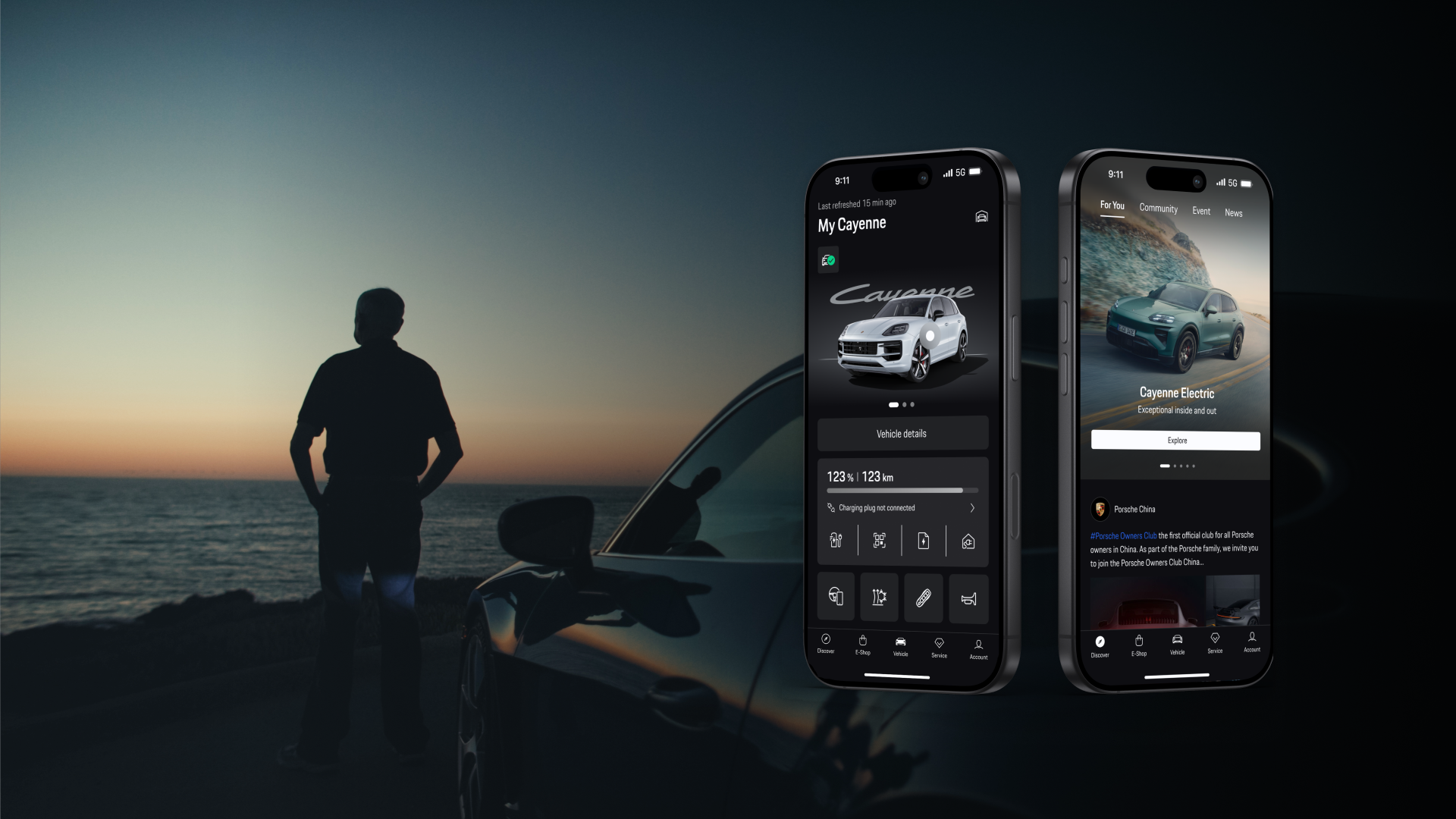
Before 2024, Porsche customers in China faced a disjointed digital experience scattered across WeChat Mini-programs, Tmall, and standalone apps. This fragmentation created high cognitive load and diluted the brand's premium feel.
As the Lead UX Designer, I spearheaded the end-to-end transformation. I facilitated the Inception Workshops, aligning cross-functional stakeholders on a unified Product Vision and North Star metrics. Moving from strategy to execution, I led the actual design delivery of the Super App, orchestrating a seamless user journey that bridges the gap between digital accessibility and brand scarcity.
The result is a centralized hub that serves over 1 million users, connecting the entire ownership lifecycle, from vehicle configuration to exclusive lifestyle events, within a single, cohesive ecosystem.
Chapter 01: The Challenge & Context
Taking a deeper dive into the pre-2024 landscape, we mapped out the user’s disjointed journey across unconnected silos—from WeChat Mini-programs to Tmall and offline dealerships. This section visualizes the specific friction points and high cognitive load that plagued the legacy ecosystem, establishing the critical "Why" behind the need for a centralized Super App strategy.
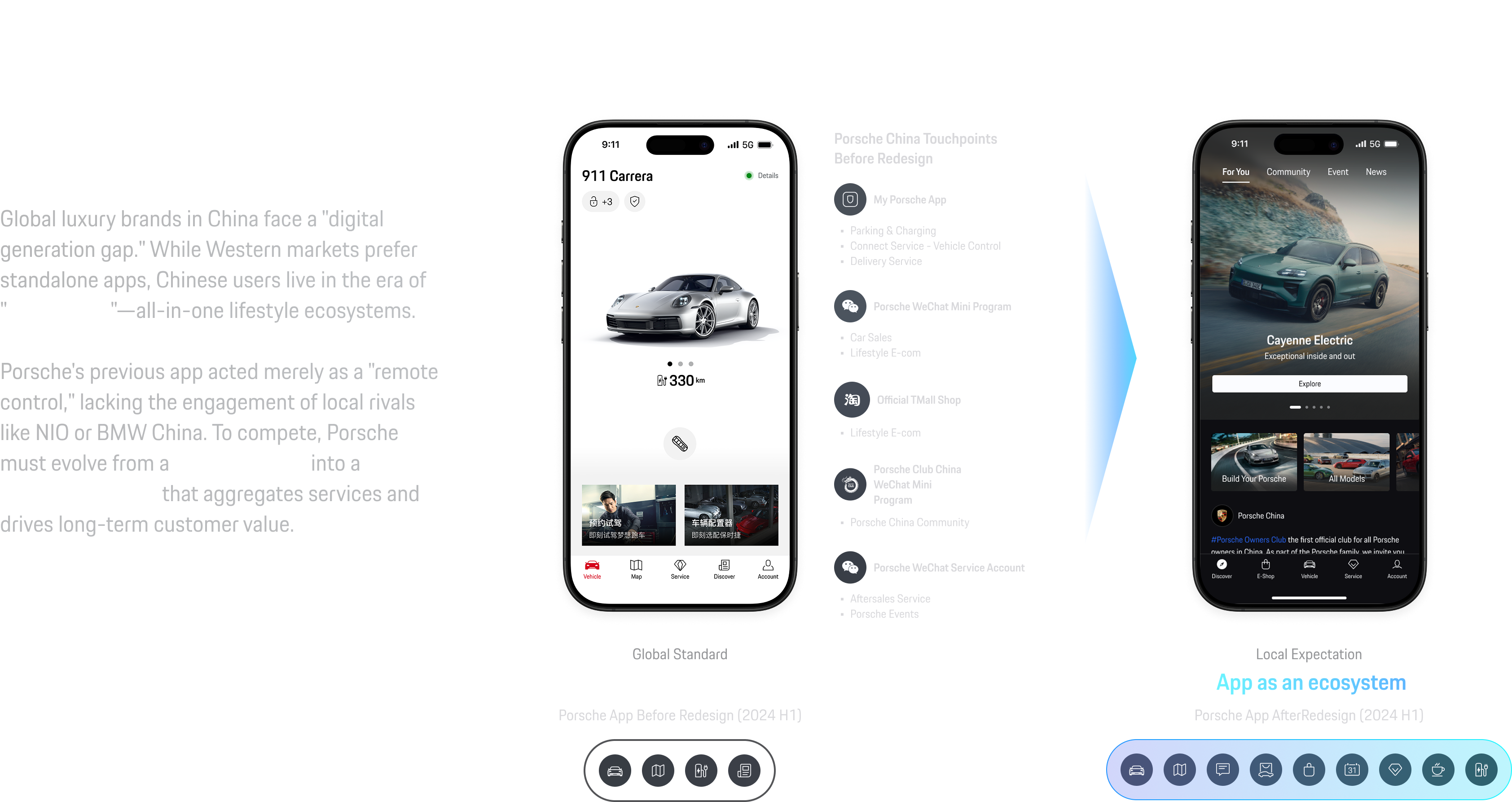
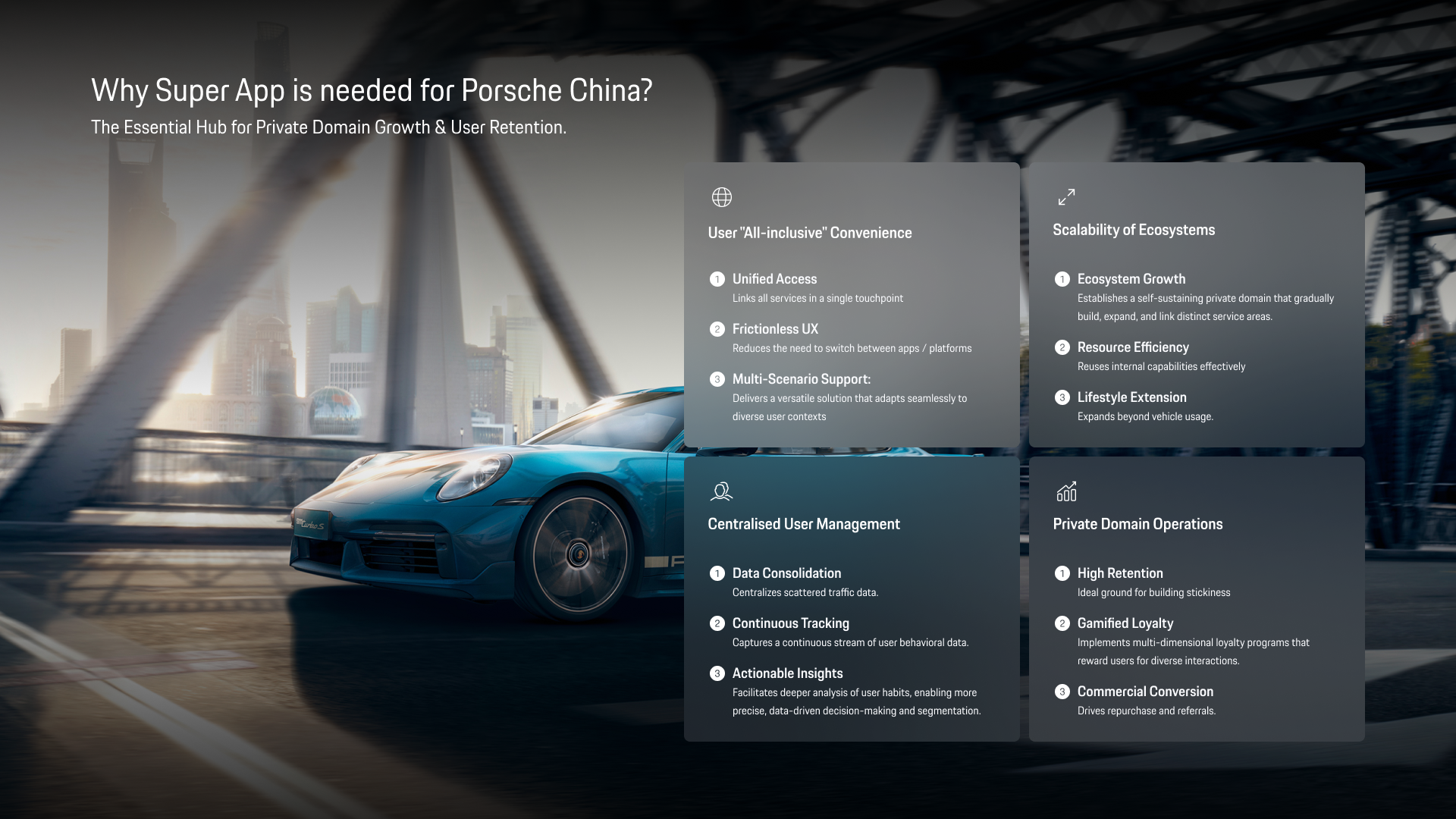
Given the unique digital habits of Chinese consumers, the Super App is now a prerequisite for effective multi-scenario B2C interaction. For automakers, it represents a vital private domain strategy to capture traffic and drive long-term retention.
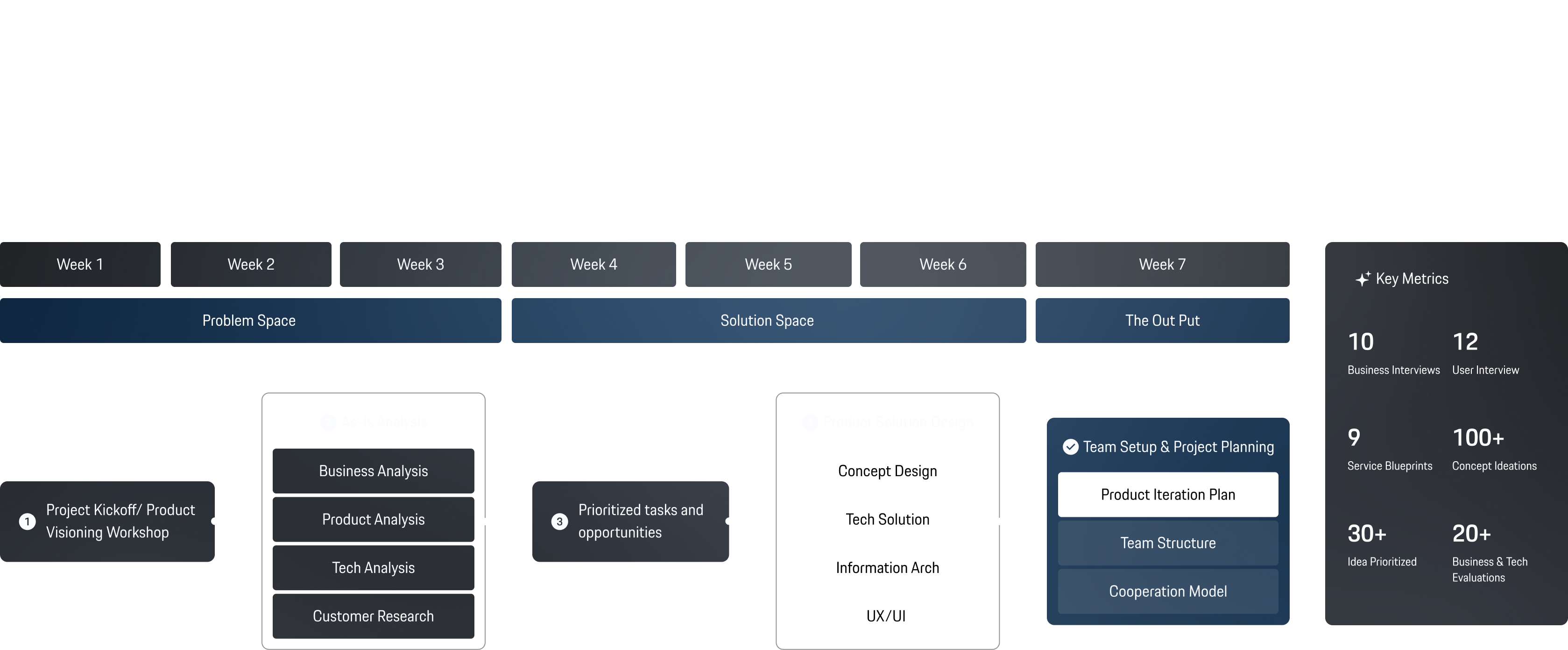
A cross-disciplinary team has been constructed and conducted a full-spectrum investigation of As-is digital product of Porsche China including the business/product/tech and customer aspects
Chapter 02: Strategy & Definition
Before a single pixel was drawn, we needed alignment. I facilitated Inception Workshops to shift the organizational focus from short-term vanity metrics to sustainable business value. By utilizing the Product Vision Board and KPI mapping frameworks, we established a shared strategic direction: building an ecosystem driven by Customer Lifetime Value (CLV) and high-quality leads.
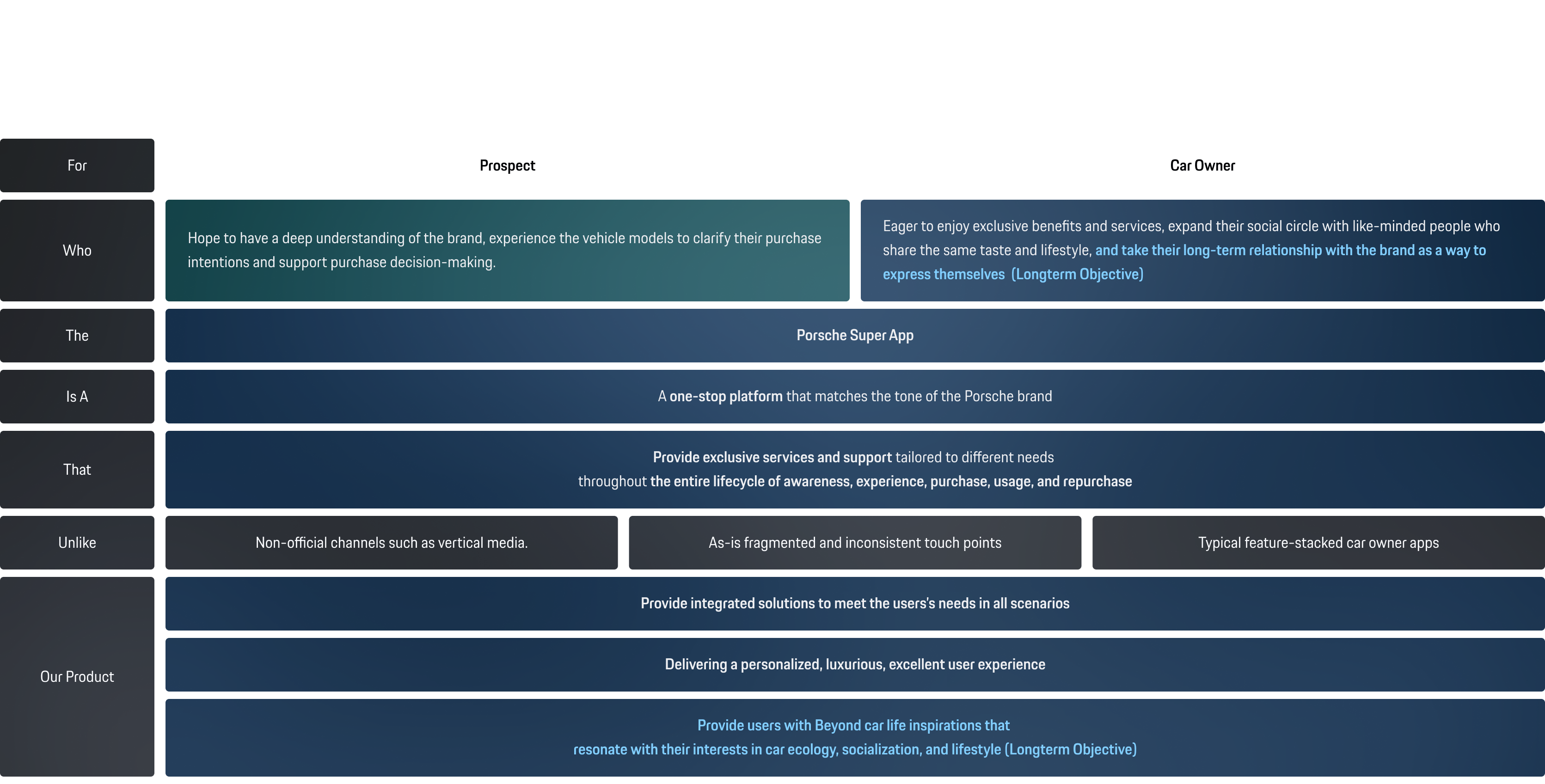
The Product Vision Board was created to align the cross-functional team on a singular goal: transforming scattered digital touchpoints into a cohesive 'All-in-One' luxury experience. It defines our target users, key differentiators, and the strategic value of connecting the full user lifecycle.
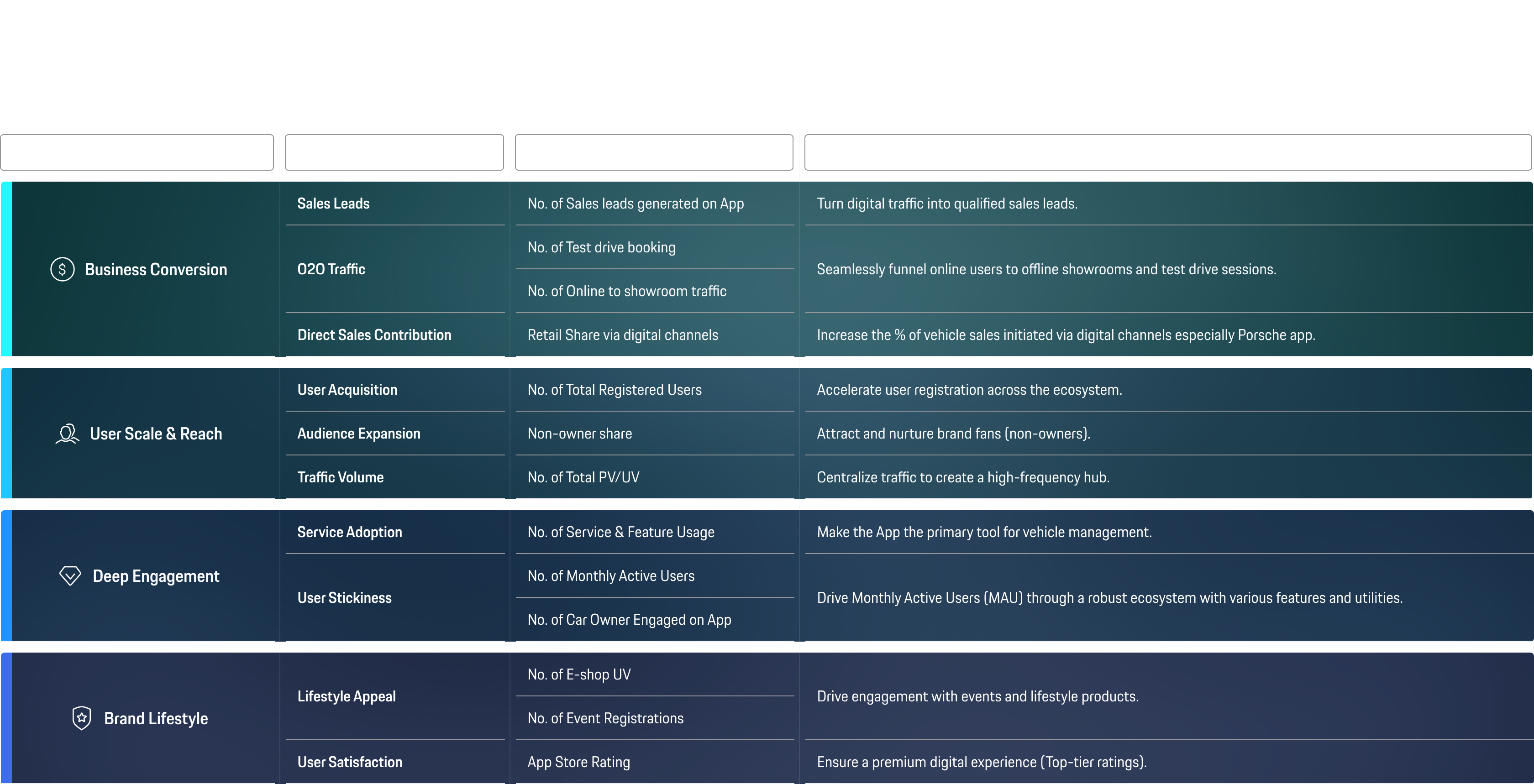
Redefining success was the first step in our transformation. Moving beyond vanity metrics like 'downloads,' we established a robust measurement framework anchored in Customer Lifetime Value (CLV). We identified four strategic pillars: Commercial Conversion, User Scale, Deep Engagement, and Brand Experience, to ensure every design decision directly contributed to business velocity. This data-driven approach allowed us to shift the conversation from 'subjective aesthetics' to 'objective impact,' aligning design outputs with the company's core revenue and retention goals.
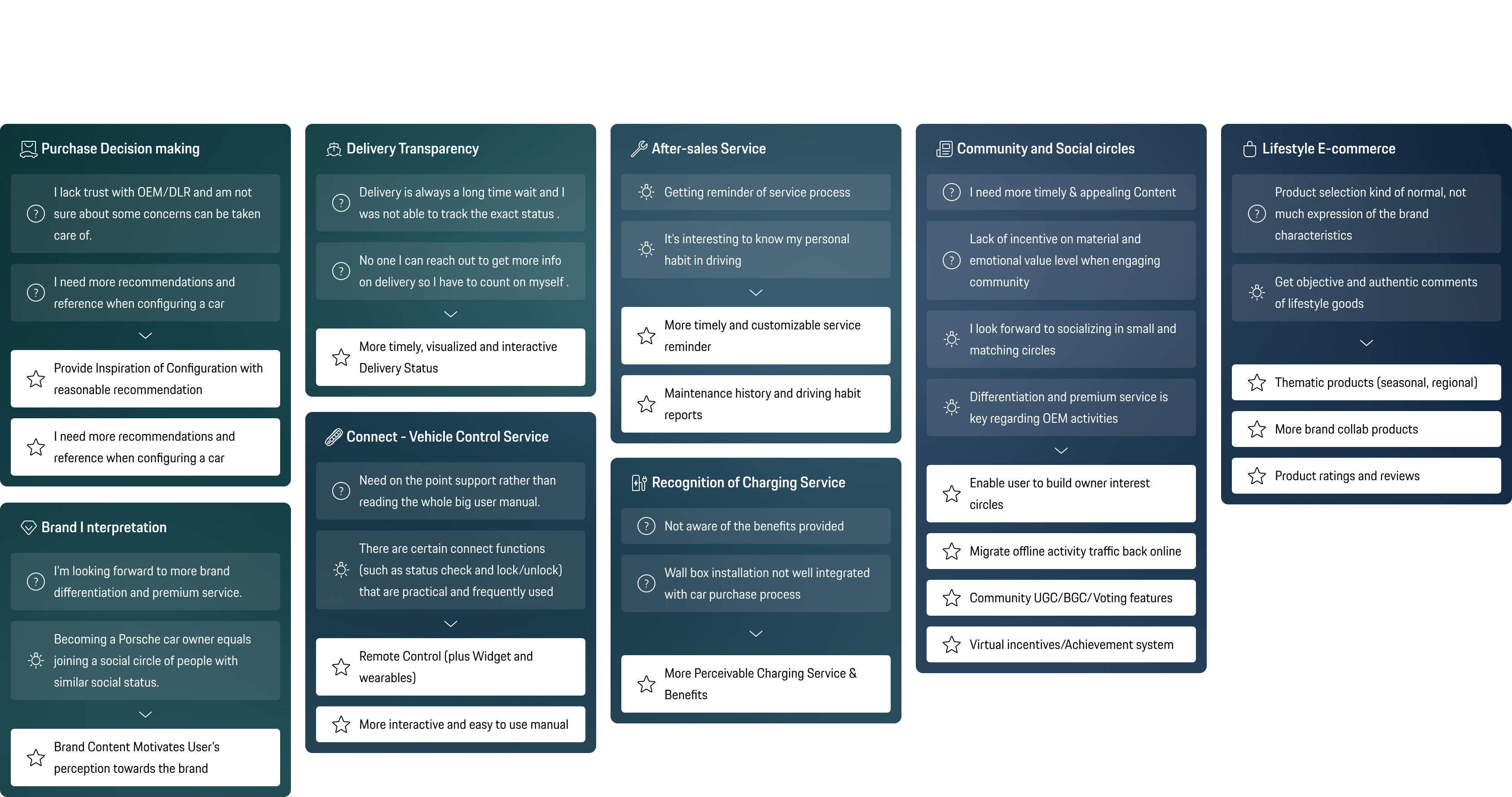
Our solutions were defined by rigorous investigation, not assumptions. We conducted a comprehensive audit across all business modules using four key methods: User Interviews, Stakeholder Interviews, Tech Analysis, and Desk Research.
This deep dive allowed us to pinpoint specific user pain points and functional gaps within each service area, from vehicle control to community engagement. By mapping these evidence-based insights directly to business needs, we formulated targeted solutions for each functional group, ensuring every design decision solved a verified problem.
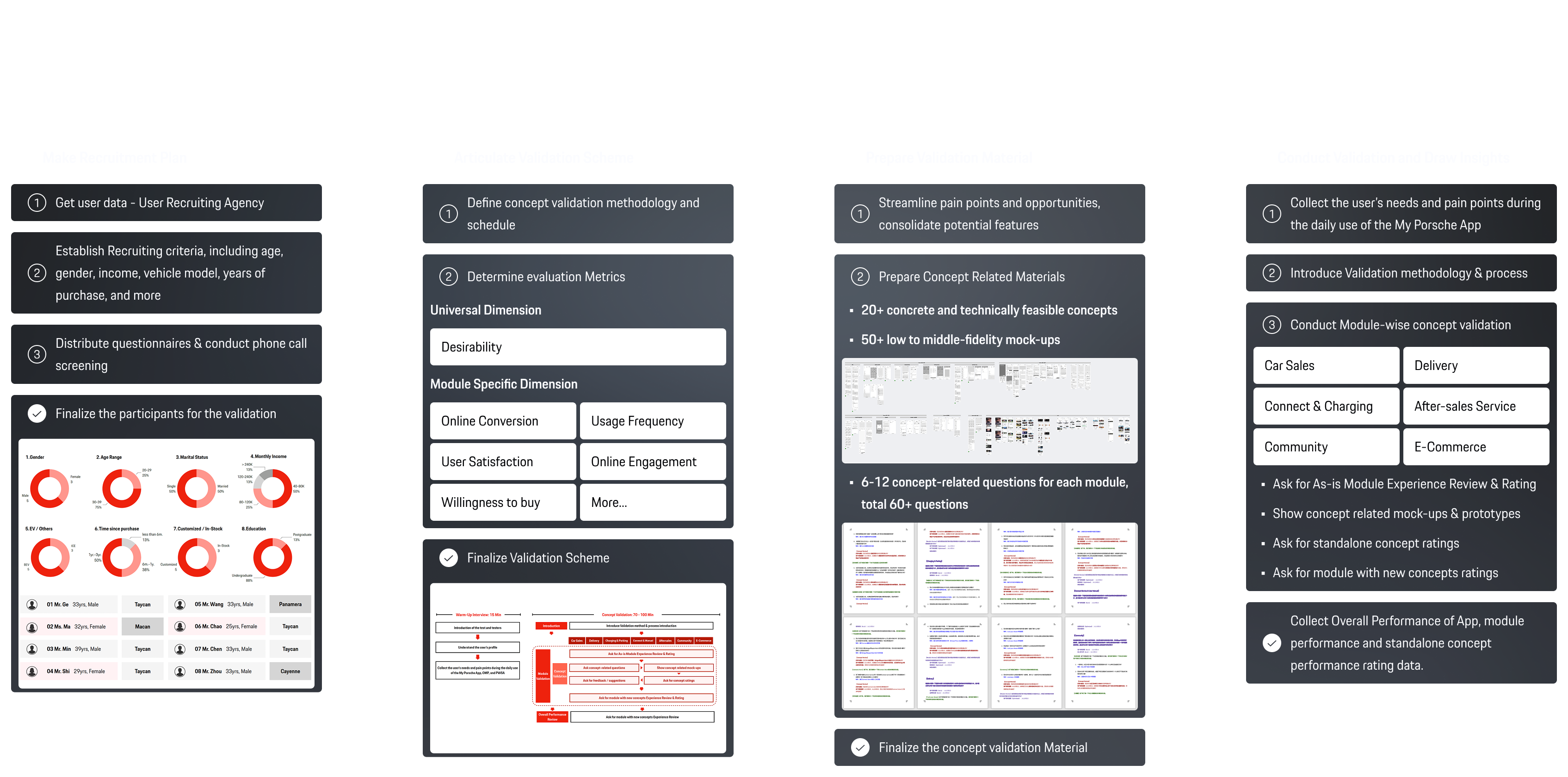
Innovation requires rigorous validation. To de-risk our design decisions before development, we implemented a structured Concept Validation Framework. We conducted a series of user testing sessions, utilizing rapid prototyping to test hypotheses against real user behaviors. This process wasn't just about usability testing; it was a strategic alignment tool that allowed us to validate the 'Desirability' of new lifestyle features and the 'Feasibility' of service integrations, ensuring that our final delivery was not just a design concept, but a proven product solution.
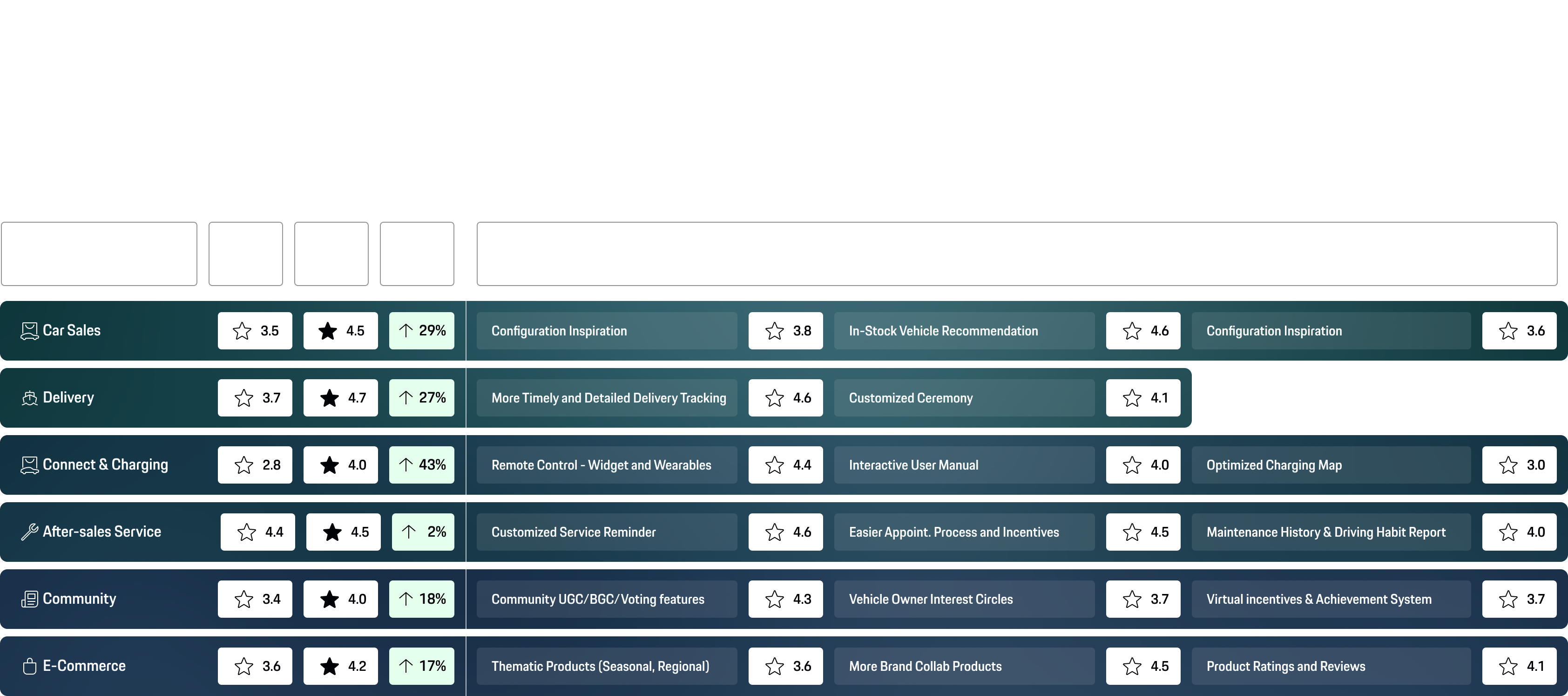
The concept validation results demonstrate a significant uplift in user satisfaction driven by the new design integration. Across core vehicle ownership scenarios, we observed score increases ranging from 17% to 43%. Notably, the 'Connect & Charging' module achieved the highest growth at 43%, validating that the proposed solutions effectively address critical user pain points in the EV experience.
Chapter 03: Design Execution
Translating strategy into interface. This section showcases the end-to-end design delivery, from information architecture to high-fidelity UI systems. We balanced complex functional requirements—such as vehicle control, service booking, and community engagement—with the minimalist elegance of the Porsche brand, creating a seamless flow that feels both intuitive and luxurious.
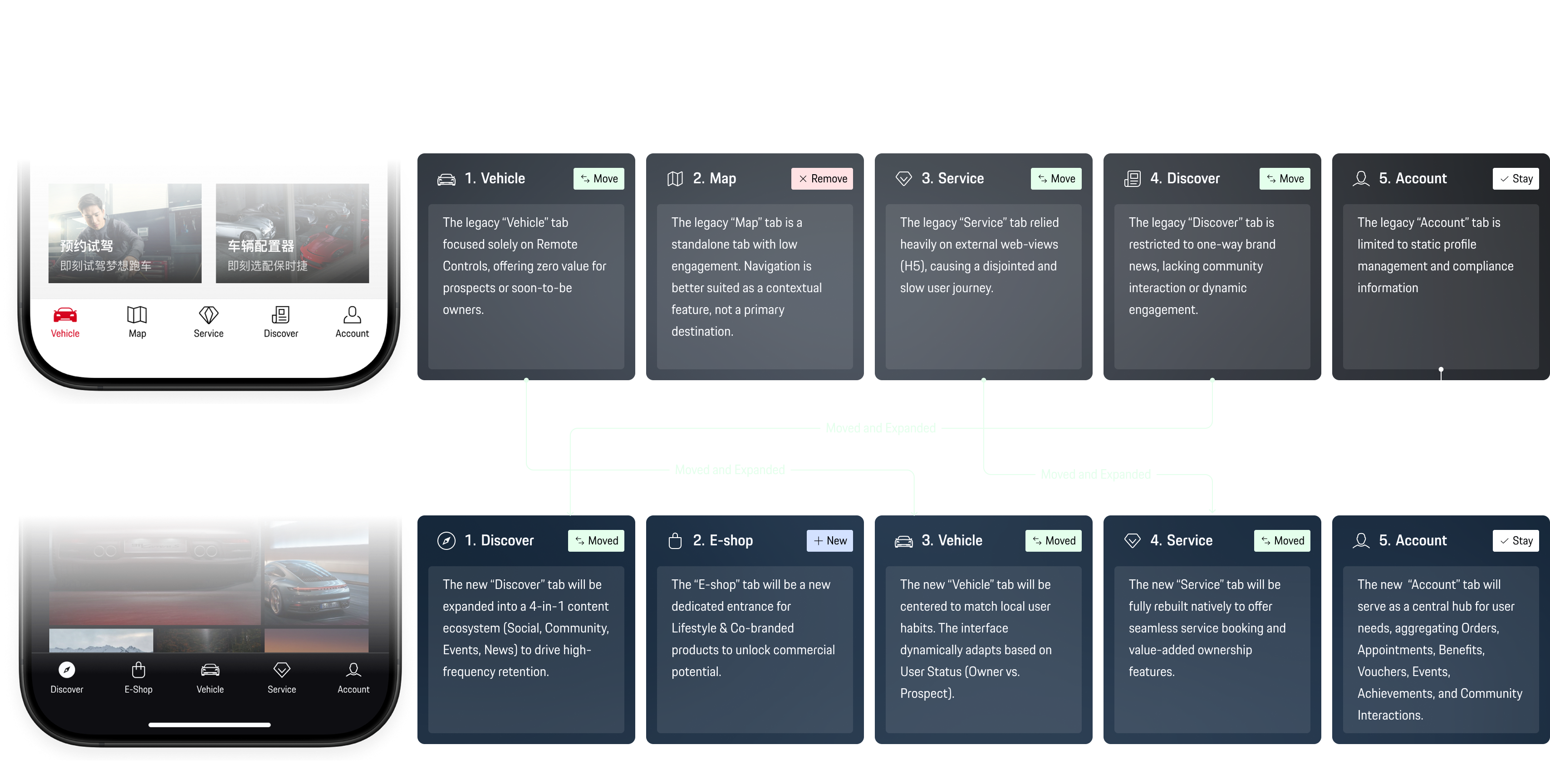
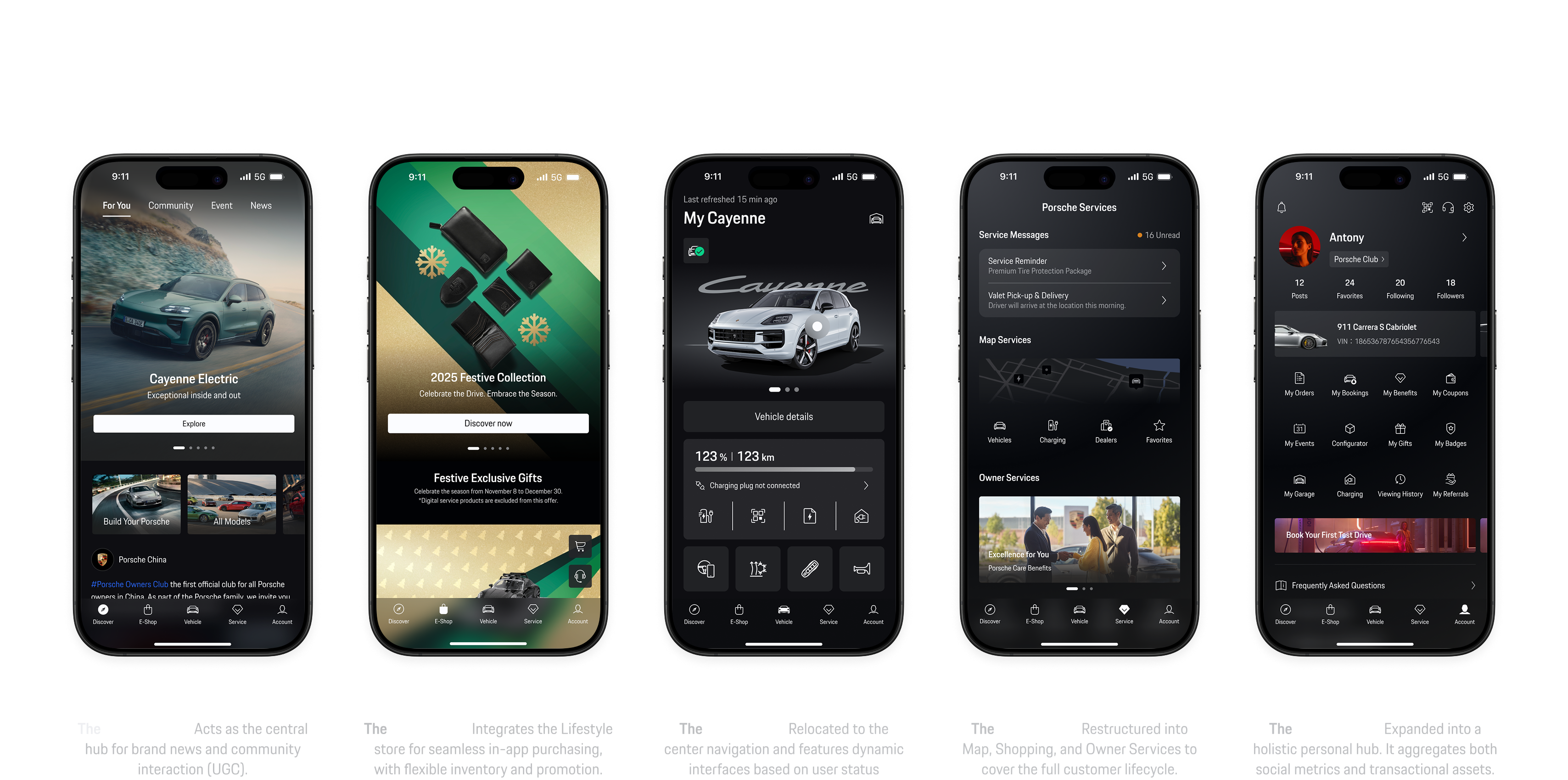
We completely restructured the navigation to align with Chinese user habits and local market trends. Through benchmarking against top domestic players (like Nio and LiAuto), we made three strategic moves:
- Elevating Content & Commerce: We added 'Discover' (Community/Events) and 'E-shop' as primary tabs. These are 'must-have' features in China, and placing them in the tab bar shortens the path to value for users.
- Centralizing the Core: We moved the 'Vehicle' tab from the 1st to the center 3rd position. This places the most high-frequency control hub exactly where Chinese users expect it.
- Contextualizing Tools: We removed the standalone 'Map' tab, transforming it from a navigation item into a functional tool integrated precisely where users need it.
Finally, the entire interface was updated to a new Mobile Design System, ensuring a unified and modern visual experience."
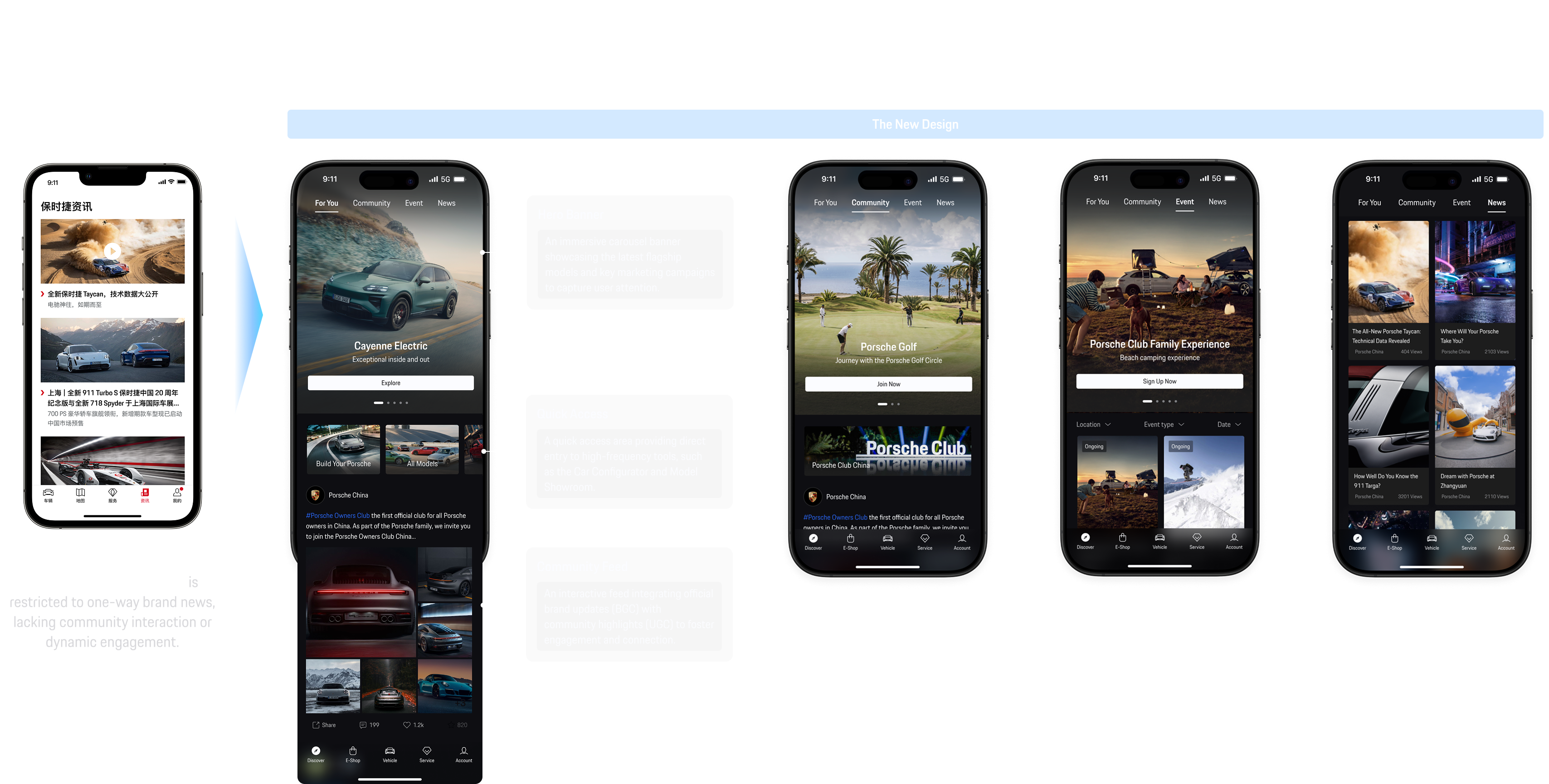
Discover Tab: The Content & Community Hub Serving as the central hub for brand ecosystem and information, this tab allows users to access the latest news, events, and club updates. It also fosters community engagement by enabling users to share UGC (User Generated Content) through posts and articles. Technically, the tab leverages a Web-view framework, granting the operations team the agility to publish real-time updates and campaign content without requiring app releases.
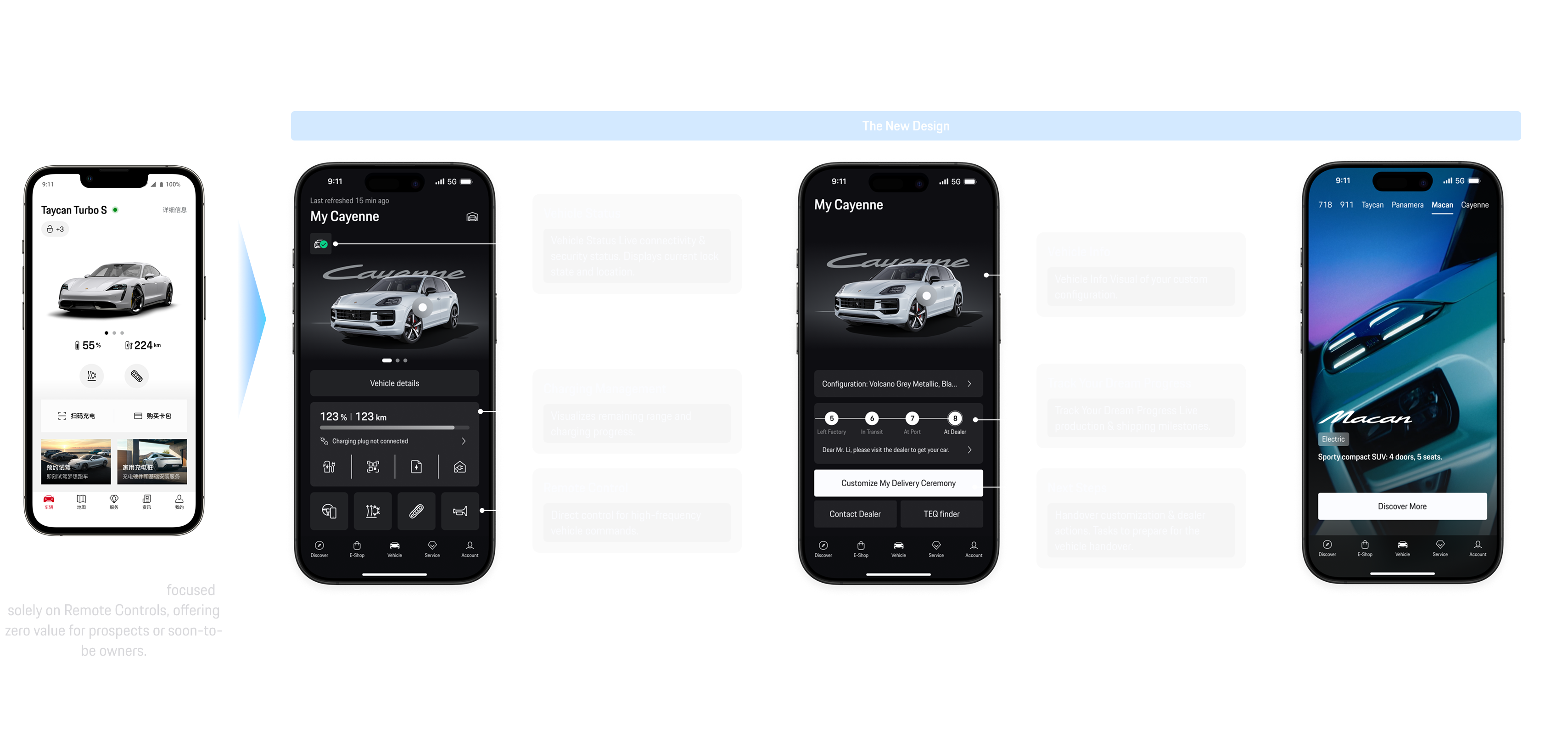
Vehicle Tab: This tab represents the most significant structural shift in the redesign.
Strategic Realignment: Based on competitive benchmarking and Chinese user behavior analysis, we relocated the Vehicle Tab from the far left to the center of the bottom navigation, aligning with the user's mental model for their most frequently accessed page. Also, We designed tailored experiences for different user stages: Prospects: Model info and ads for conversion, To-be Owners: "Track Your Dream" for real-time delivery status, Owners: Essential vehicle controls and charging management.
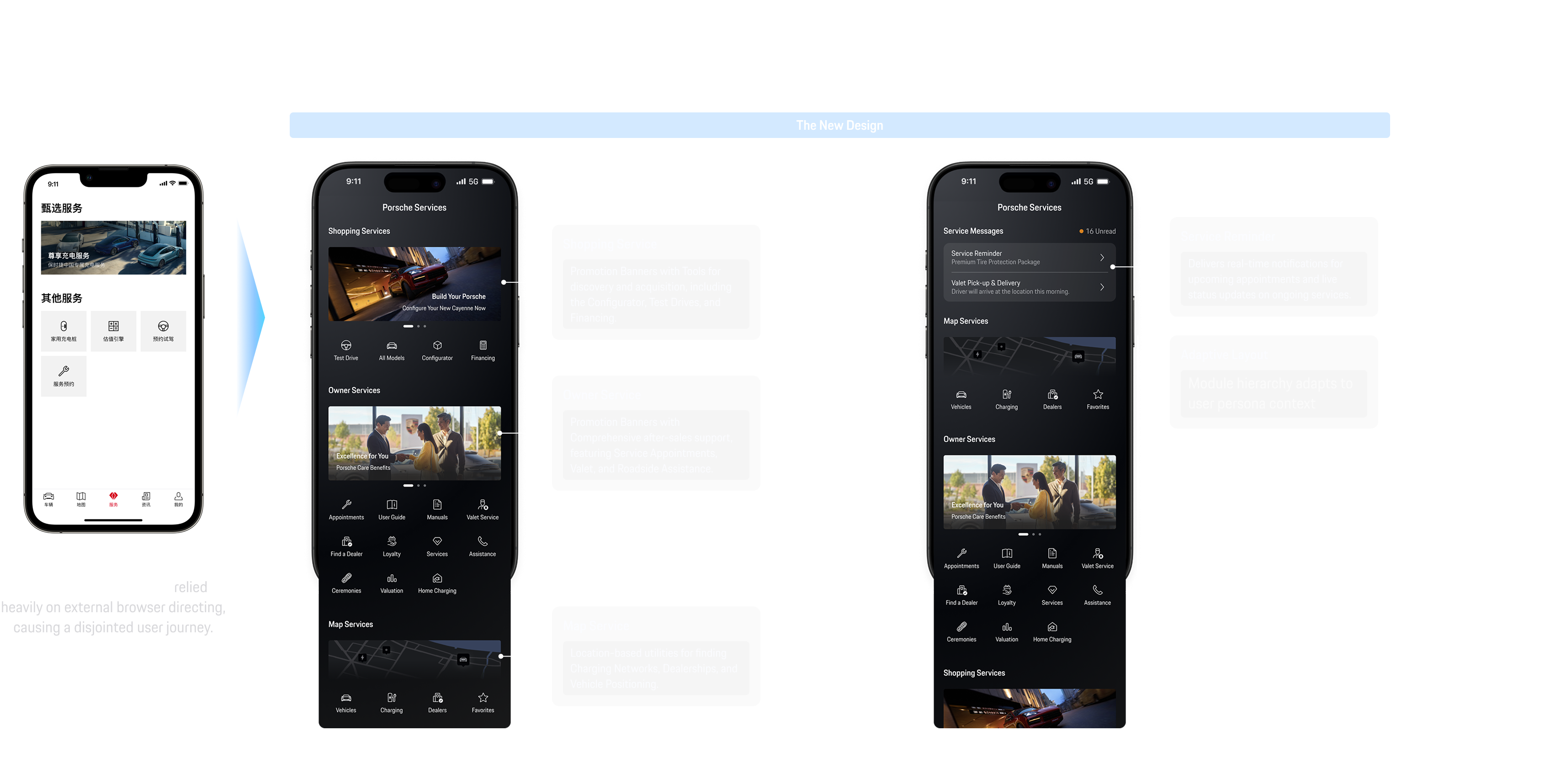
Service Tab: Adaptive Layout Strategy - Module hierarchy adapts to user persona context: For Prospects: "Shopping Services" are prioritized at the top to drive interest and conversion; For Owners: "Map" and "Owner Services" are elevated for high-frequency daily utility.
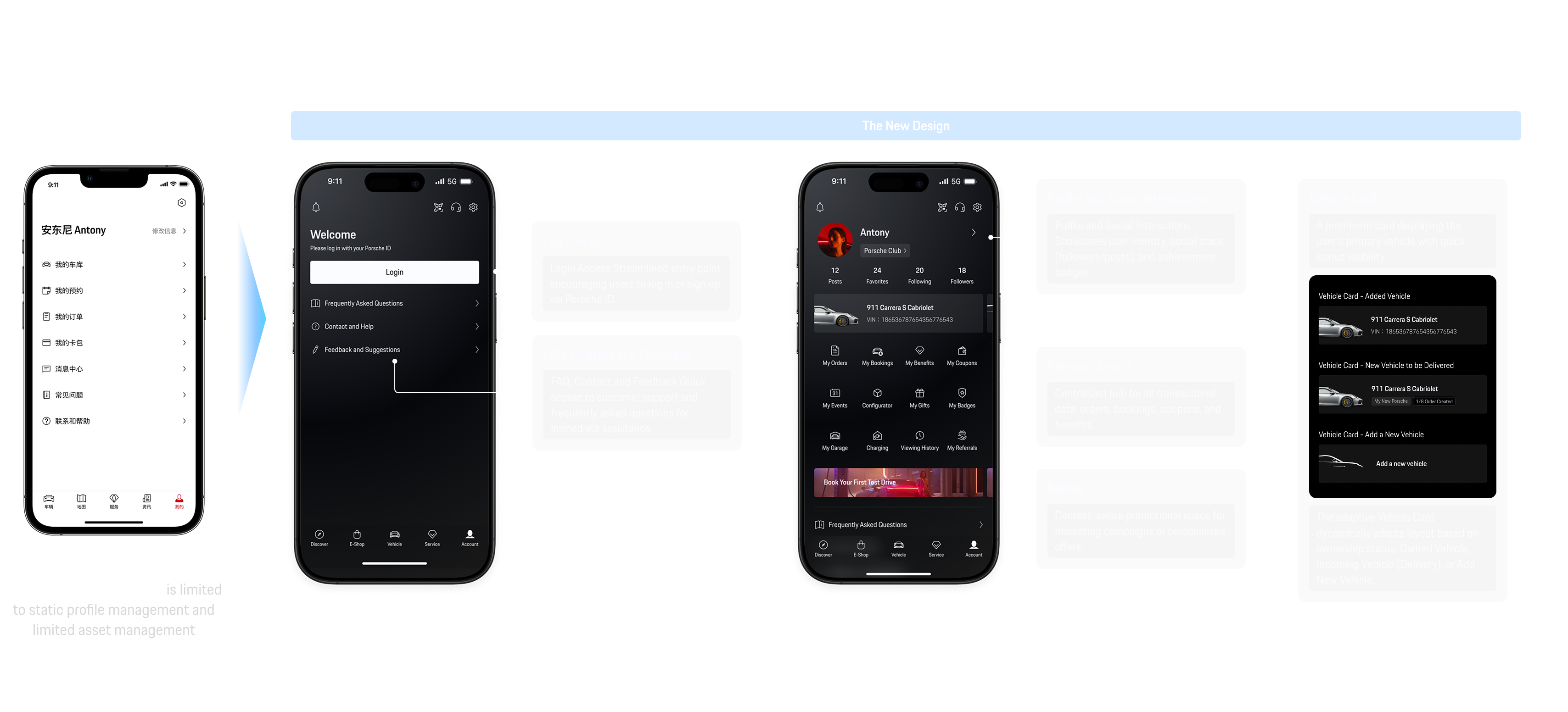
Account Tab: The Personal Digital Asset Hub Transformed from a static settings page into a dynamic Personal Digital Asset Hub, the new design unifies the user's digital relationship with Porsche. It aggregates fragmented touchpoints—social interactions, vehicle management, and transactional records—into a single, holistic interface. The architecture is fully adaptive, seamlessly adjusting content for visitors, prospective buyers, and owners to ensure relevance at every stage of the customer lifecycle.
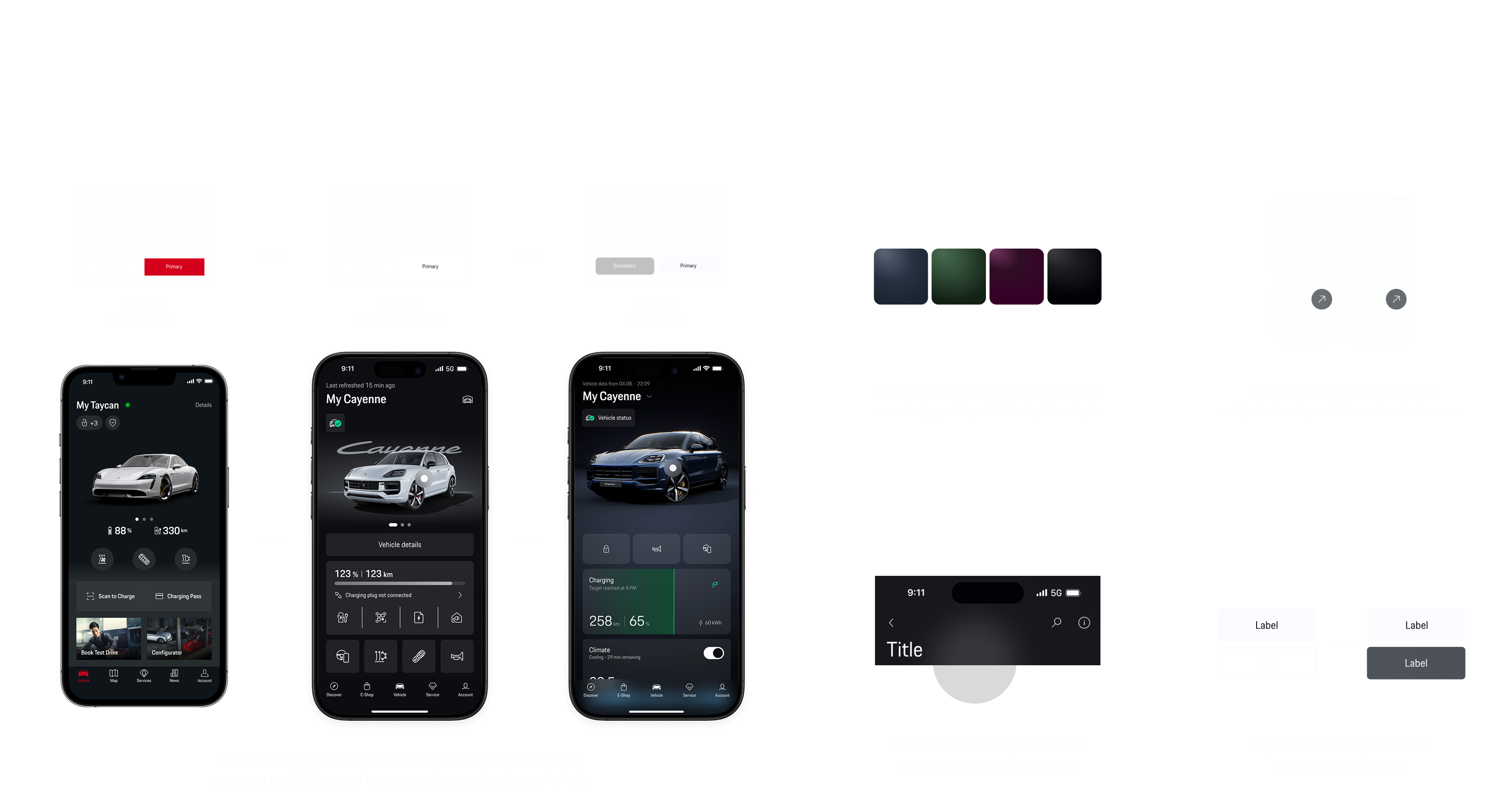
To support the rapid iteration of the Super App and ensure a consistent brand experience, we upgraded our design language to the new Mobile Design System.
Key Changes & Rationale:
- Modernized Visuals: We moved from a card-based, boxed layout to a more open, borderless aesthetic with larger typography and cleaner spacing. This aligns with modern UI trends and reduces visual clutter on smaller screens.
- Atomic Scalability: We transitioned from bespoke screens to a rigorous Atomic Design structure. By standardizing core components (like buttons, lists, and navigation bars), we accelerated development velocity and ensured pixel-perfect consistency across all business modules.
- Variable Themes Ready: The new system utilizes Design Variables to support dynamic theming. Built with accessibility in mind, it adapts seamlessly to user preferences (such as color themes) while ensuring the premium feel that resonates with Porsche's luxury identity remains consistent in any context.
Chapter 04: Business Impact
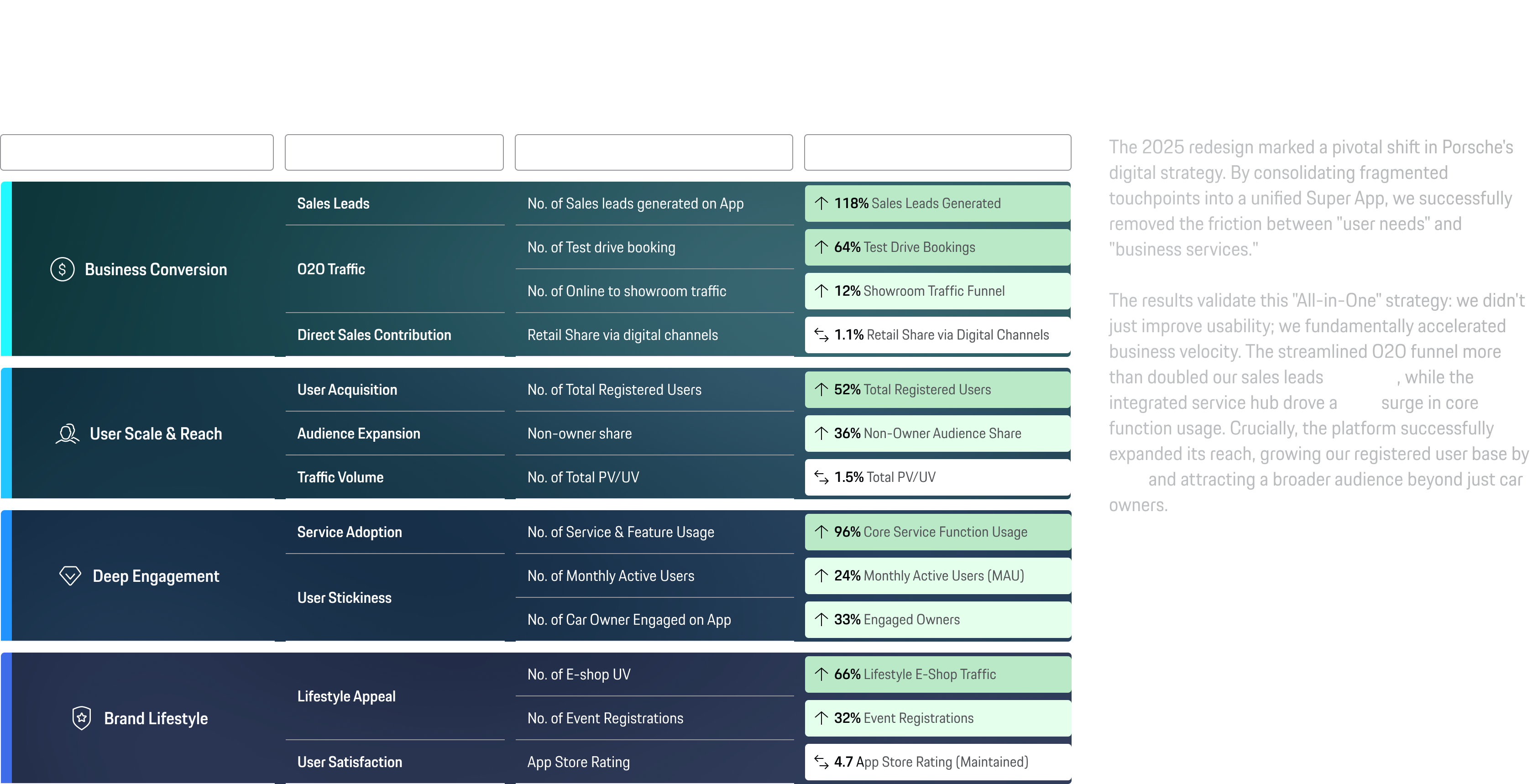
Design is a business driver. Here we present the quantifiable impact of the redesign in 2025. By removing friction from the O2O funnel, the new Super App didn't just improve satisfaction—it generated double-digit growth in sales leads and service utilization, proving that a superior user experience directly correlates with bottom-line revenue.
Chapter 05: Reflection & Insight
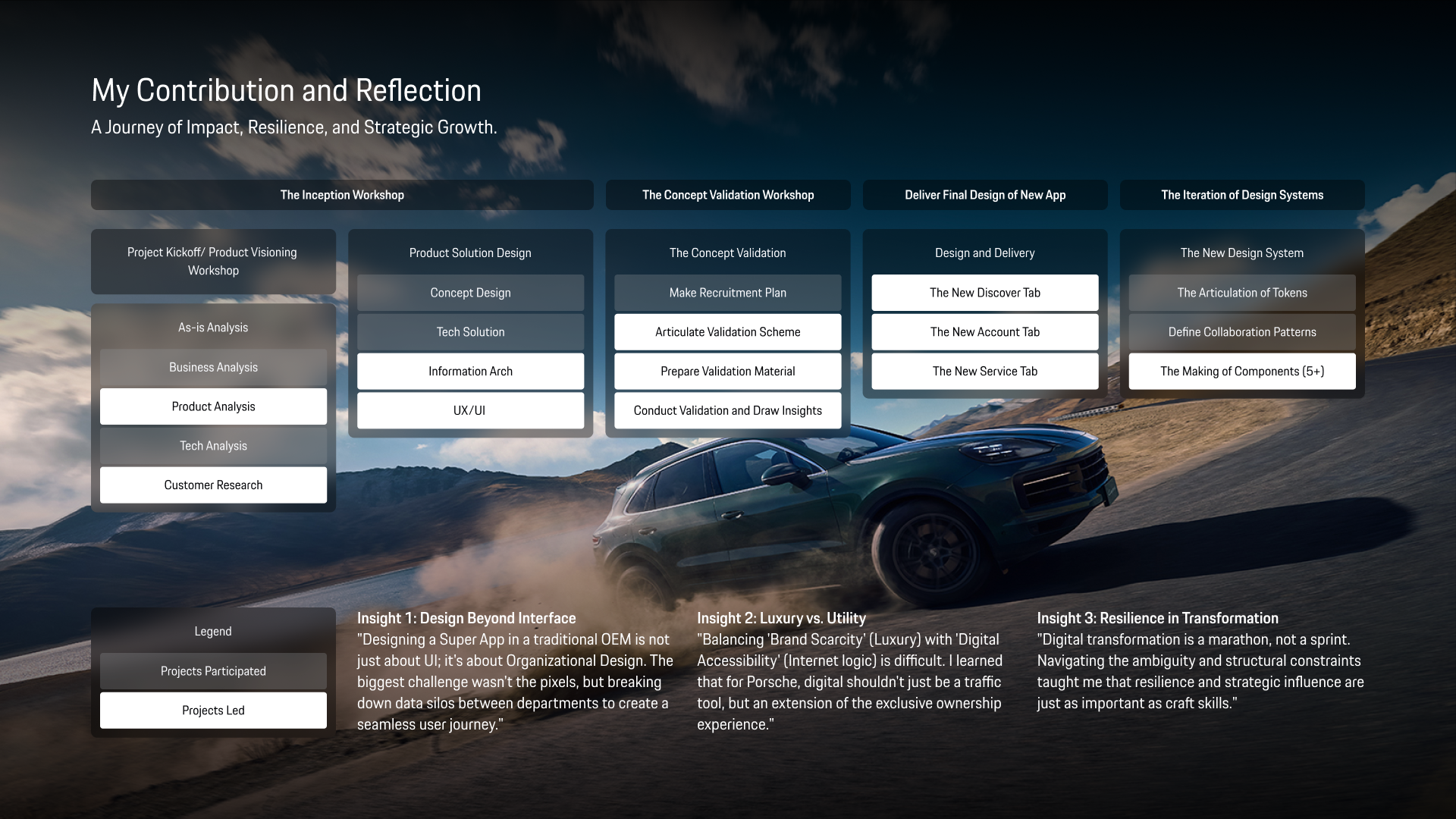
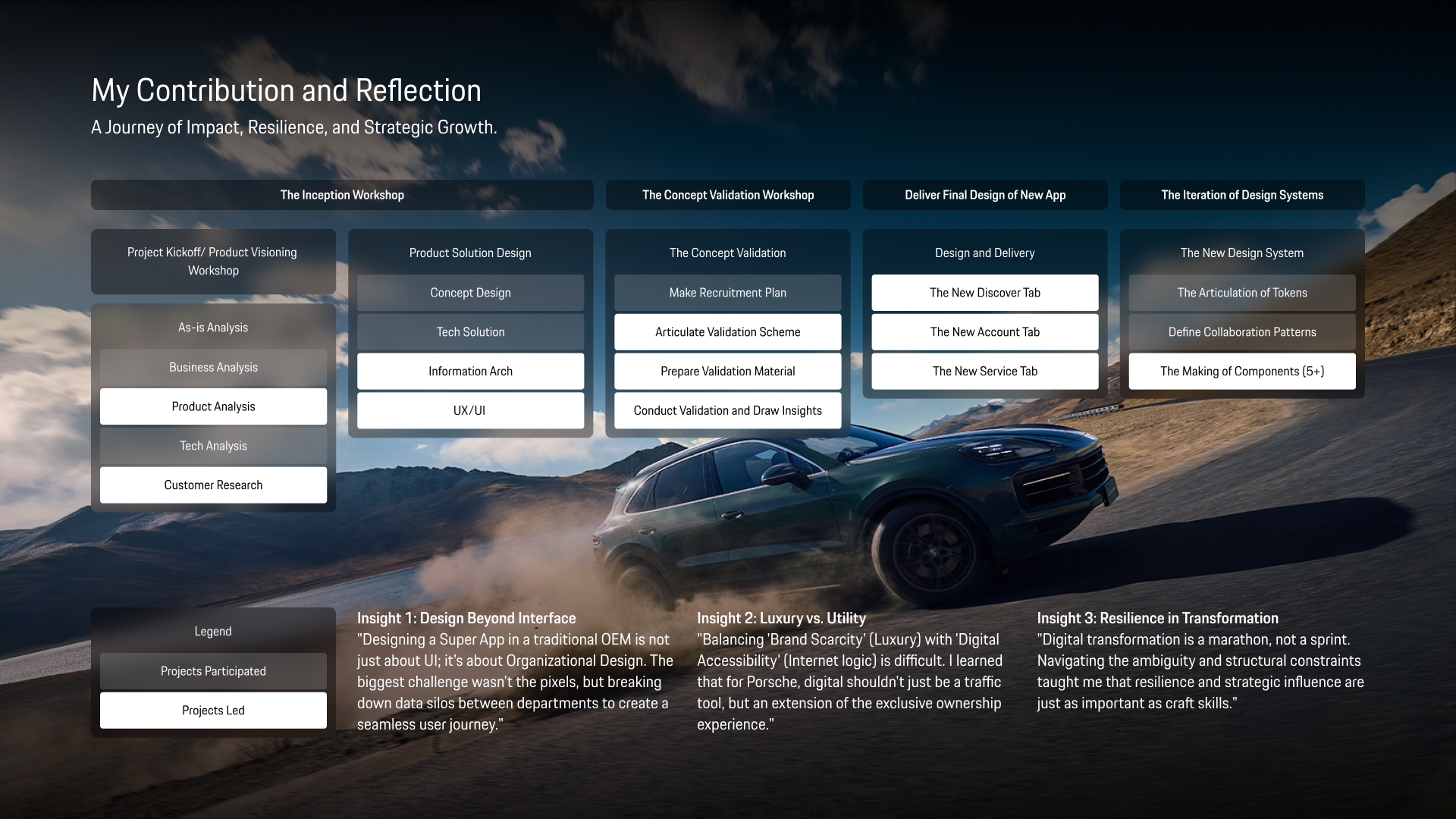
Digital transformation in a heritage OEM is a marathon, not a sprint. This concluding section reflects on my 2.5-year journey navigating organizational complexity. It explores the delicate balance between "Brand Scarcity" and "Digital Accessibility," sharing key lessons learned on resilience, stakeholder management, and the evolving role of design in driving corporate strategy.

From Strategy to Launch, tailored for Chinese Market
My Porsche App Redesign

Project Type
Mobile App
Timeline
August 2023 – Recent
My Role
Lead Product Designer
Tools
Figma, Miro, Jira, Confluence
Before 2024, Porsche customers in China faced a disjointed digital experience scattered across WeChat Mini-programs, Tmall, and standalone apps. This fragmentation created high cognitive load and diluted the brand's premium feel.
As the Lead UX Designer, I spearheaded the end-to-end transformation. I facilitated the Inception Workshops, aligning cross-functional stakeholders on a unified Product Vision and North Star metrics. Moving from strategy to execution, I led the actual design delivery of the Super App, orchestrating a seamless user journey that bridges the gap between digital accessibility and brand scarcity.
The result is a centralized hub that serves over 1 million users, connecting the entire ownership lifecycle, from vehicle configuration to exclusive lifestyle events, within a single, cohesive ecosystem.
Chapter 01: The Challenge & Context
Taking a deeper dive into the pre-2024 landscape, we mapped out the user’s disjointed journey across unconnected silos—from WeChat Mini-programs to Tmall and offline dealerships. This section visualizes the specific friction points and high cognitive load that plagued the legacy ecosystem, establishing the critical "Why" behind the need for a centralized Super App strategy.
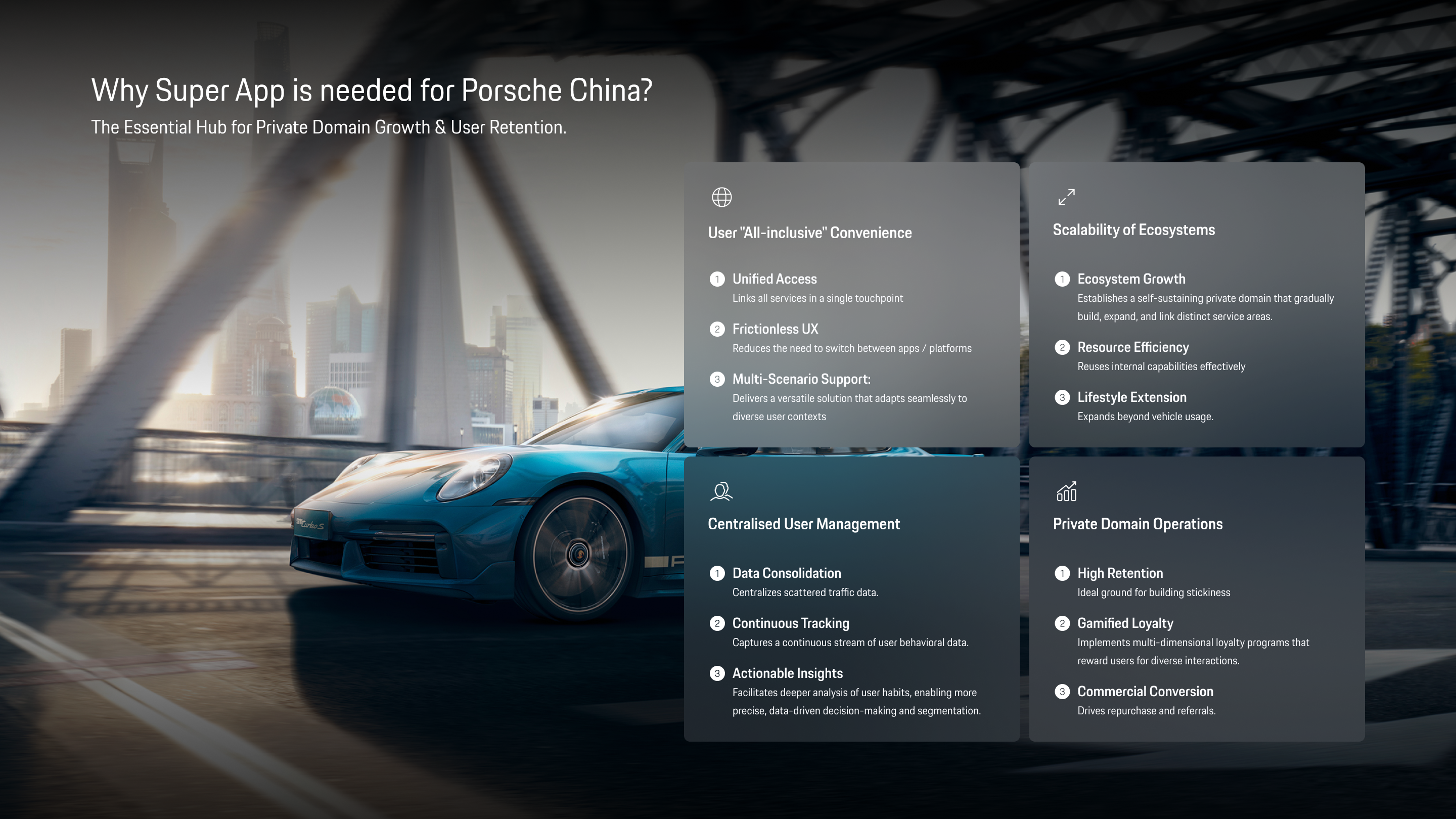
Given the unique digital habits of Chinese consumers, the Super App is now a prerequisite for effective multi-scenario B2C interaction. For automakers, it represents a vital private domain strategy to capture traffic and drive long-term retention.
A cross-disciplinary team has been constructed and conducted a full-spectrum investigation of As-is digital product of Porsche China including the business/product/tech and customer aspects
Chapter 02: Strategy & Definition
Before a single pixel was drawn, we needed alignment. I facilitated Inception Workshops to shift the organizational focus from short-term vanity metrics to sustainable business value. By utilizing the Product Vision Board and KPI mapping frameworks, we established a shared strategic direction: building an ecosystem driven by Customer Lifetime Value (CLV) and high-quality leads.
The Product Vision Board was created to align the cross-functional team on a singular goal: transforming scattered digital touchpoints into a cohesive 'All-in-One' luxury experience. It defines our target users, key differentiators, and the strategic value of connecting the full user lifecycle.
Redefining success was the first step in our transformation. Moving beyond vanity metrics like 'downloads,' we established a robust measurement framework anchored in Customer Lifetime Value (CLV). We identified four strategic pillars: Commercial Conversion, User Scale, Deep Engagement, and Brand Experience, to ensure every design decision directly contributed to business velocity. This data-driven approach allowed us to shift the conversation from 'subjective aesthetics' to 'objective impact,' aligning design outputs with the company's core revenue and retention goals.
Our solutions were defined by rigorous investigation, not assumptions. We conducted a comprehensive audit across all business modules using four key methods: User Interviews, Stakeholder Interviews, Tech Analysis, and Desk Research.
This deep dive allowed us to pinpoint specific user pain points and functional gaps within each service area, from vehicle control to community engagement. By mapping these evidence-based insights directly to business needs, we formulated targeted solutions for each functional group, ensuring every design decision solved a verified problem.
Innovation requires rigorous validation. To de-risk our design decisions before development, we implemented a structured Concept Validation Framework. We conducted a series of user testing sessions, utilizing rapid prototyping to test hypotheses against real user behaviors. This process wasn't just about usability testing; it was a strategic alignment tool that allowed us to validate the 'Desirability' of new lifestyle features and the 'Feasibility' of service integrations, ensuring that our final delivery was not just a design concept, but a proven product solution.
The concept validation results demonstrate a significant uplift in user satisfaction driven by the new design integration. Across core vehicle ownership scenarios, we observed score increases ranging from 17% to 43%. Notably, the 'Connect & Charging' module achieved the highest growth at 43%, validating that the proposed solutions effectively address critical user pain points in the EV experience.
Chapter 03: Design Execution
Translating strategy into interface. This section showcases the end-to-end design delivery, from information architecture to high-fidelity UI systems. We balanced complex functional requirements—such as vehicle control, service booking, and community engagement—with the minimalist elegance of the Porsche brand, creating a seamless flow that feels both intuitive and luxurious.
We completely restructured the navigation to align with Chinese user habits and local market trends. Through benchmarking against top domestic players (like Nio and LiAuto), we made three strategic moves:
- Elevating Content & Commerce: We added 'Discover' (Community/Events) and 'E-shop' as primary tabs. These are 'must-have' features in China, and placing them in the tab bar shortens the path to value for users.
- Centralizing the Core: We moved the 'Vehicle' tab from the 1st to the center 3rd position. This places the most high-frequency control hub exactly where Chinese users expect it.
- Contextualizing Tools: We removed the standalone 'Map' tab, transforming it from a navigation item into a functional tool integrated precisely where users need it.
Finally, the entire interface was updated to a new Mobile Design System, ensuring a unified and modern visual experience."
Discover Tab: The Content & Community Hub Serving as the central hub for brand ecosystem and information, this tab allows users to access the latest news, events, and club updates. It also fosters community engagement by enabling users to share UGC (User Generated Content) through posts and articles. Technically, the tab leverages a Web-view framework, granting the operations team the agility to publish real-time updates and campaign content without requiring app releases.
Vehicle Tab: This tab represents the most significant structural shift in the redesign.
Strategic Realignment: Based on competitive benchmarking and Chinese user behavior analysis, we relocated the Vehicle Tab from the far left to the center of the bottom navigation, aligning with the user's mental model for their most frequently accessed page. Also, We designed tailored experiences for different user stages: Prospects: Model info and ads for conversion, To-be Owners: "Track Your Dream" for real-time delivery status, Owners: Essential vehicle controls and charging management.
Service Tab: Adaptive Layout Strategy - Module hierarchy adapts to user persona context: For Prospects: "Shopping Services" are prioritized at the top to drive interest and conversion; For Owners: "Map" and "Owner Services" are elevated for high-frequency daily utility.
Account Tab: The Personal Digital Asset Hub Transformed from a static settings page into a dynamic Personal Digital Asset Hub, the new design unifies the user's digital relationship with Porsche. It aggregates fragmented touchpoints—social interactions, vehicle management, and transactional records—into a single, holistic interface. The architecture is fully adaptive, seamlessly adjusting content for visitors, prospective buyers, and owners to ensure relevance at every stage of the customer lifecycle.
To support the rapid iteration of the Super App and ensure a consistent brand experience, we upgraded our design language to the new Mobile Design System.
Key Changes & Rationale:
- Modernized Visuals: We moved from a card-based, boxed layout to a more open, borderless aesthetic with larger typography and cleaner spacing. This aligns with modern UI trends and reduces visual clutter on smaller screens.
- Atomic Scalability: We transitioned from bespoke screens to a rigorous Atomic Design structure. By standardizing core components (like buttons, lists, and navigation bars), we accelerated development velocity and ensured pixel-perfect consistency across all business modules.
- Variable Themes Ready: The new system utilizes Design Variables to support dynamic theming. Built with accessibility in mind, it adapts seamlessly to user preferences (such as color themes) while ensuring the premium feel that resonates with Porsche's luxury identity remains consistent in any context.
Chapter 04: Business Impact
Design is a business driver. Here we present the quantifiable impact of the redesign in 2025. By removing friction from the O2O funnel, the new Super App didn't just improve satisfaction—it generated double-digit growth in sales leads and service utilization, proving that a superior user experience directly correlates with bottom-line revenue.
Chapter 05: Reflection & Insight
Digital transformation in a heritage OEM is a marathon, not a sprint. This concluding section reflects on my 2.5-year journey navigating organizational complexity. It explores the delicate balance between "Brand Scarcity" and "Digital Accessibility," sharing key lessons learned on resilience, stakeholder management, and the evolving role of design in driving corporate strategy.

SI ZHENG
From Strategy to Launch, tailored for Chinese Market
My Porsche App Redesign

Project Type
Mobile App
Timeline
August 2023 – Recent
My Role
Lead Product Designer
Tools
Figma, Miro, Jira, Confluence
Before 2024, Porsche customers in China faced a disjointed digital experience scattered across WeChat Mini-programs, Tmall, and standalone apps. This fragmentation created high cognitive load and diluted the brand's premium feel.
As the Lead UX Designer, I spearheaded the end-to-end transformation. I facilitated the Inception Workshops, aligning cross-functional stakeholders on a unified Product Vision and North Star metrics. Moving from strategy to execution, I led the actual design delivery of the Super App, orchestrating a seamless user journey that bridges the gap between digital accessibility and brand scarcity.
The result is a centralized hub that serves over 1 million users, connecting the entire ownership lifecycle, from vehicle configuration to exclusive lifestyle events, within a single, cohesive ecosystem.
Chapter 01: The Challenge & Context
Taking a deeper dive into the pre-2024 landscape, we mapped out the user’s disjointed journey across unconnected silos—from WeChat Mini-programs to Tmall and offline dealerships. This section visualizes the specific friction points and high cognitive load that plagued the legacy ecosystem, establishing the critical "Why" behind the need for a centralized Super App strategy.
Given the unique digital habits of Chinese consumers, the Super App is now a prerequisite for effective multi-scenario B2C interaction. For automakers, it represents a vital private domain strategy to capture traffic and drive long-term retention.
A cross-disciplinary team has been constructed and conducted a full-spectrum investigation of As-is digital product of Porsche China including the business/product/tech and customer aspects
Chapter 02: Strategy & Definition
Before a single pixel was drawn, we needed alignment. I facilitated Inception Workshops to shift the organizational focus from short-term vanity metrics to sustainable business value. By utilizing the Product Vision Board and KPI mapping frameworks, we established a shared strategic direction: building an ecosystem driven by Customer Lifetime Value (CLV) and high-quality leads.
The Product Vision Board was created to align the cross-functional team on a singular goal: transforming scattered digital touchpoints into a cohesive 'All-in-One' luxury experience. It defines our target users, key differentiators, and the strategic value of connecting the full user lifecycle.
Redefining success was the first step in our transformation. Moving beyond vanity metrics like 'downloads,' we established a robust measurement framework anchored in Customer Lifetime Value (CLV). We identified four strategic pillars: Commercial Conversion, User Scale, Deep Engagement, and Brand Experience, to ensure every design decision directly contributed to business velocity. This data-driven approach allowed us to shift the conversation from 'subjective aesthetics' to 'objective impact,' aligning design outputs with the company's core revenue and retention goals.
Our solutions were defined by rigorous investigation, not assumptions. We conducted a comprehensive audit across all business modules using four key methods: User Interviews, Stakeholder Interviews, Tech Analysis, and Desk Research.
This deep dive allowed us to pinpoint specific user pain points and functional gaps within each service area, from vehicle control to community engagement. By mapping these evidence-based insights directly to business needs, we formulated targeted solutions for each functional group, ensuring every design decision solved a verified problem.
Innovation requires rigorous validation. To de-risk our design decisions before development, we implemented a structured Concept Validation Framework. We conducted a series of user testing sessions, utilizing rapid prototyping to test hypotheses against real user behaviors. This process wasn't just about usability testing; it was a strategic alignment tool that allowed us to validate the 'Desirability' of new lifestyle features and the 'Feasibility' of service integrations, ensuring that our final delivery was not just a design concept, but a proven product solution.
The concept validation results demonstrate a significant uplift in user satisfaction driven by the new design integration. Across core vehicle ownership scenarios, we observed score increases ranging from 17% to 43%. Notably, the 'Connect & Charging' module achieved the highest growth at 43%, validating that the proposed solutions effectively address critical user pain points in the EV experience.
Chapter 03: Design Execution
Translating strategy into interface. This section showcases the end-to-end design delivery, from information architecture to high-fidelity UI systems. We balanced complex functional requirements—such as vehicle control, service booking, and community engagement—with the minimalist elegance of the Porsche brand, creating a seamless flow that feels both intuitive and luxurious.
We completely restructured the navigation to align with Chinese user habits and local market trends. Through benchmarking against top domestic players (like Nio and LiAuto), we made three strategic moves:
- Elevating Content & Commerce: We added 'Discover' (Community/Events) and 'E-shop' as primary tabs. These are 'must-have' features in China, and placing them in the tab bar shortens the path to value for users.
- Centralizing the Core: We moved the 'Vehicle' tab from the 1st to the center 3rd position. This places the most high-frequency control hub exactly where Chinese users expect it.
- Contextualizing Tools: We removed the standalone 'Map' tab, transforming it from a navigation item into a functional tool integrated precisely where users need it.
Finally, the entire interface was updated to a new Mobile Design System, ensuring a unified and modern visual experience."
Discover Tab: The Content & Community Hub Serving as the central hub for brand ecosystem and information, this tab allows users to access the latest news, events, and club updates. It also fosters community engagement by enabling users to share UGC (User Generated Content) through posts and articles. Technically, the tab leverages a Web-view framework, granting the operations team the agility to publish real-time updates and campaign content without requiring app releases.
Vehicle Tab: This tab represents the most significant structural shift in the redesign.
Strategic Realignment: Based on competitive benchmarking and Chinese user behavior analysis, we relocated the Vehicle Tab from the far left to the center of the bottom navigation, aligning with the user's mental model for their most frequently accessed page. Also, We designed tailored experiences for different user stages: Prospects: Model info and ads for conversion, To-be Owners: "Track Your Dream" for real-time delivery status, Owners: Essential vehicle controls and charging management.
Service Tab: Adaptive Layout Strategy - Module hierarchy adapts to user persona context: For Prospects: "Shopping Services" are prioritized at the top to drive interest and conversion; For Owners: "Map" and "Owner Services" are elevated for high-frequency daily utility.
Account Tab: The Personal Digital Asset Hub Transformed from a static settings page into a dynamic Personal Digital Asset Hub, the new design unifies the user's digital relationship with Porsche. It aggregates fragmented touchpoints—social interactions, vehicle management, and transactional records—into a single, holistic interface. The architecture is fully adaptive, seamlessly adjusting content for visitors, prospective buyers, and owners to ensure relevance at every stage of the customer lifecycle.
To support the rapid iteration of the Super App and ensure a consistent brand experience, we upgraded our design language to the new Mobile Design System.
Key Changes & Rationale:
- Modernized Visuals: We moved from a card-based, boxed layout to a more open, borderless aesthetic with larger typography and cleaner spacing. This aligns with modern UI trends and reduces visual clutter on smaller screens.
- Atomic Scalability: We transitioned from bespoke screens to a rigorous Atomic Design structure. By standardizing core components (like buttons, lists, and navigation bars), we accelerated development velocity and ensured pixel-perfect consistency across all business modules.
- Variable Themes Ready: The new system utilizes Design Variables to support dynamic theming. Built with accessibility in mind, it adapts seamlessly to user preferences (such as color themes) while ensuring the premium feel that resonates with Porsche's luxury identity remains consistent in any context.
Chapter 04: Business Impact
Design is a business driver. Here we present the quantifiable impact of the redesign in 2025. By removing friction from the O2O funnel, the new Super App didn't just improve satisfaction—it generated double-digit growth in sales leads and service utilization, proving that a superior user experience directly correlates with bottom-line revenue.
Chapter 05: Reflection & Insight
Digital transformation in a heritage OEM is a marathon, not a sprint. This concluding section reflects on my 2.5-year journey navigating organizational complexity. It explores the delicate balance between "Brand Scarcity" and "Digital Accessibility," sharing key lessons learned on resilience, stakeholder management, and the evolving role of design in driving corporate strategy.
