User Achievement and Reward System
Porsche Badge Center

Project Type
Mobile App
Timeline
June 2024 – Recent
My Role
Product Designer
Tools
Figma,
Tablau
Adobe Illustrator
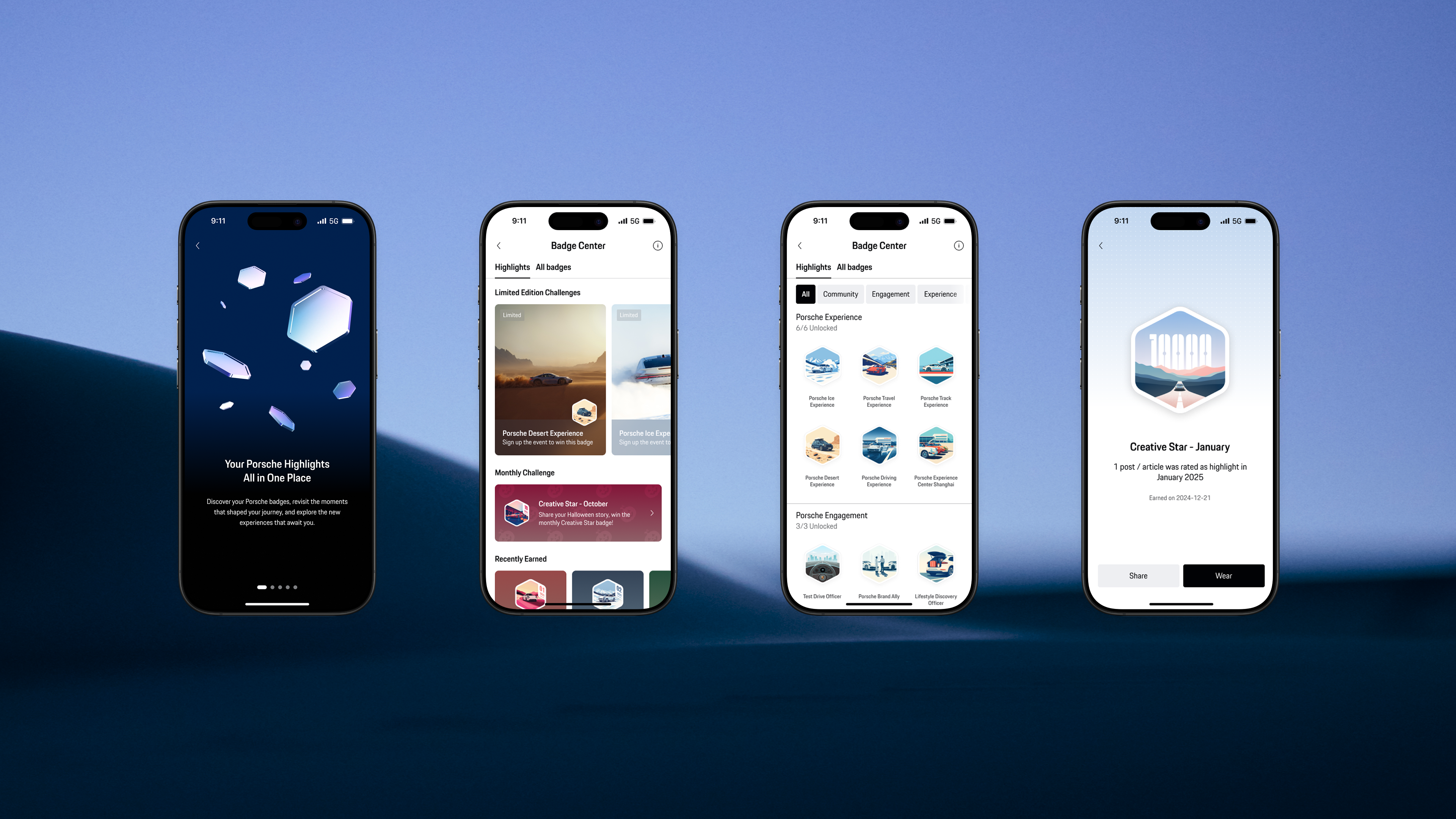
Porsche Badge Center is a digital engagement feature within the Porsche ecosystem that turns brand interactions, such as test drives, event participation, and lifestyle purchases, into collectible digital badges celebrating user milestones.
Initiated as part of a retention and engagement strategy, the project’s goal was to design a reward system that aligns with Porsche’s premium identity while encouraging ongoing participation.
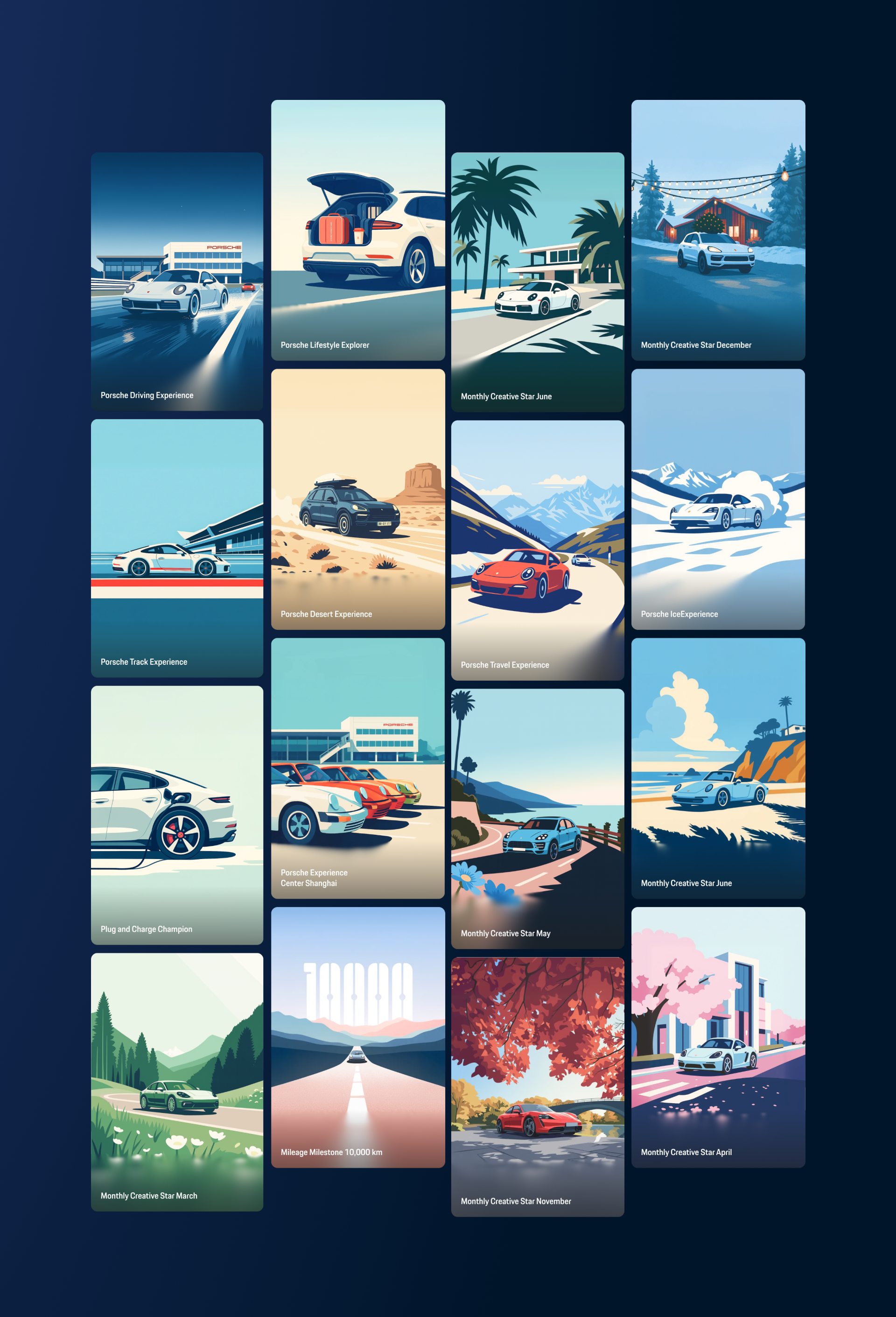
With limited design resources, an AI-assisted workflow was established to generate badge visuals at scale while maintaining stylistic consistency. Each badge draws from Porsche’s design heritage, featuring monthly themes inspired by seasonal tones and vehicle models.
The Badge Center interface allows users to browse, earn, and share badges seamlessly, integrating notification flows, tier progression, and social sharing to reinforce a sense of recognition and belonging.
Project Context
Porsche aimed to enhance user engagement and retention through a gamified digital recognition system, turning milestones such as test drives, events, and purchases into personalized achievements.
Problem Statement
“Designing a scalable, premium digital achievement system that drives engagement while preserving Porsche’s brand integrity.”
Business Value & System Roadmap
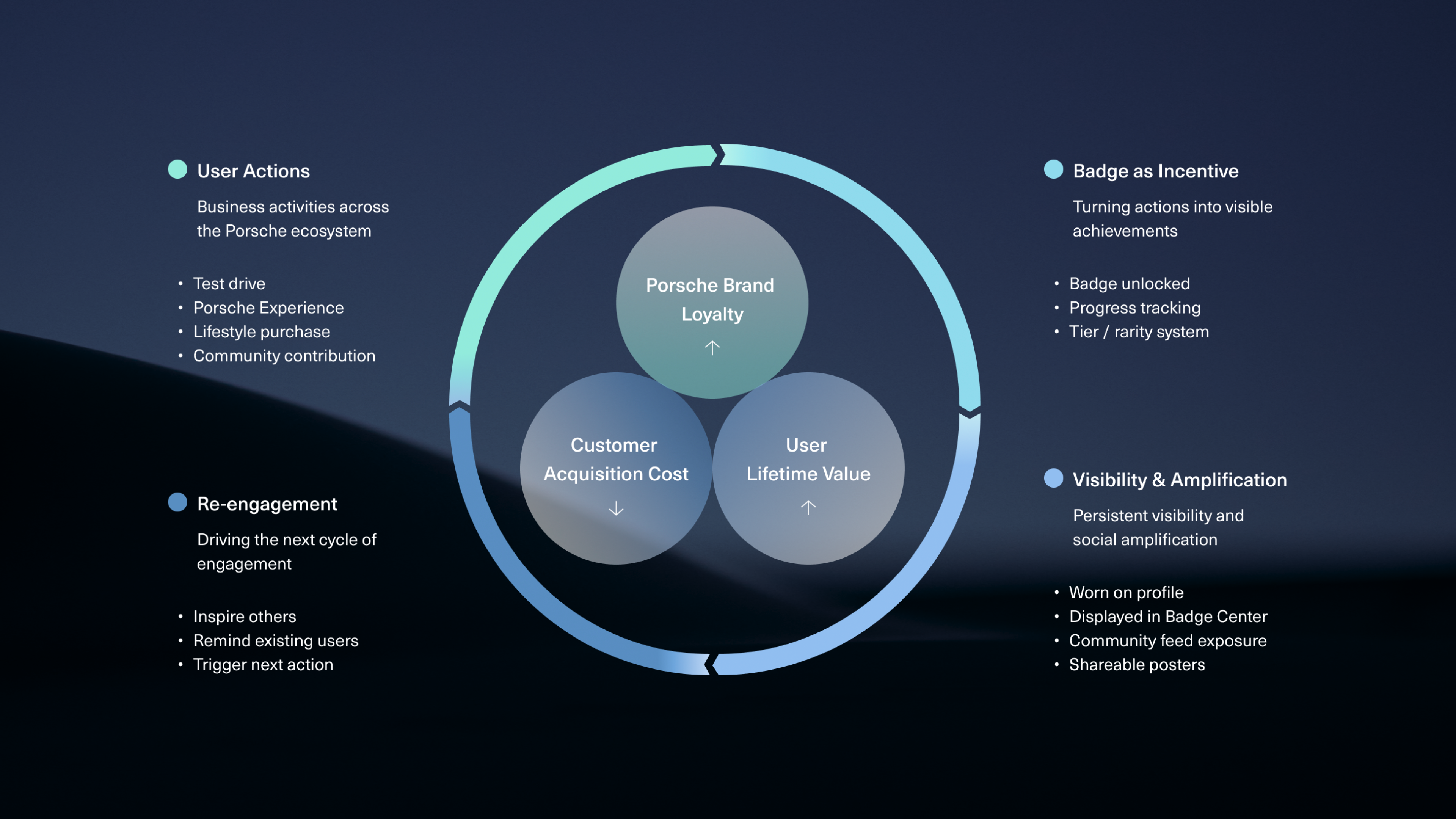
The Porsche Badge System was designed as a long-term engagement engine rather than a one-off incentive feature. By transforming meaningful user actions into visible achievements, the system reinforces participation, encourages sharing, and continuously feeds back into Porsche’s digital ecosystem.
At its core, the badge system operates as an engagement loop: user activities generate badges, badges gain visibility through profile display and community exposure, and this visibility in turn inspires further participation and brand interaction. In this way, badges function not only as rewards, but as persistent touchpoints that amplify engagement across multiple channels.
Porsche Badge - Business Value Flywheel
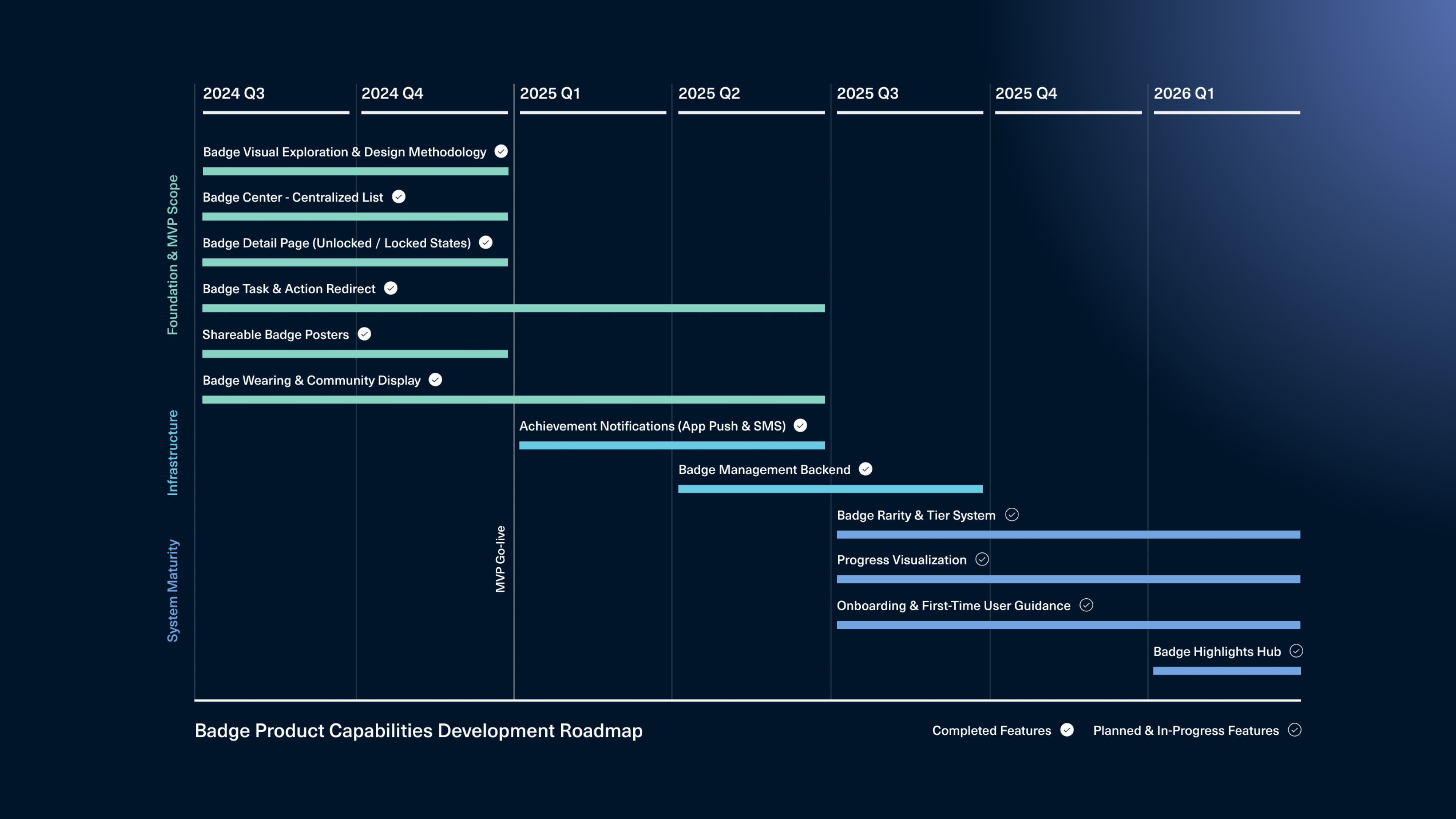
To balance business value and feasibility, the roadmap followed three phases:
Phase 1 prioritized low-effort, high-frequency scenarios (e.g., community, golf) for rapid validation. Phase 2 expanded to conversion-driven platforms like test drives to boost participation. Phase 3 targets deep vehicle integrations (e.g., Porsche Connect)—positioned later due to complexity, despite high retention potential.
This strategy ensured the system scaled effectively from lightweight incentives to deeply embedded brand touchpoints.
Porsche Badge - Product Development Roadmap

Badge Design & Visual System
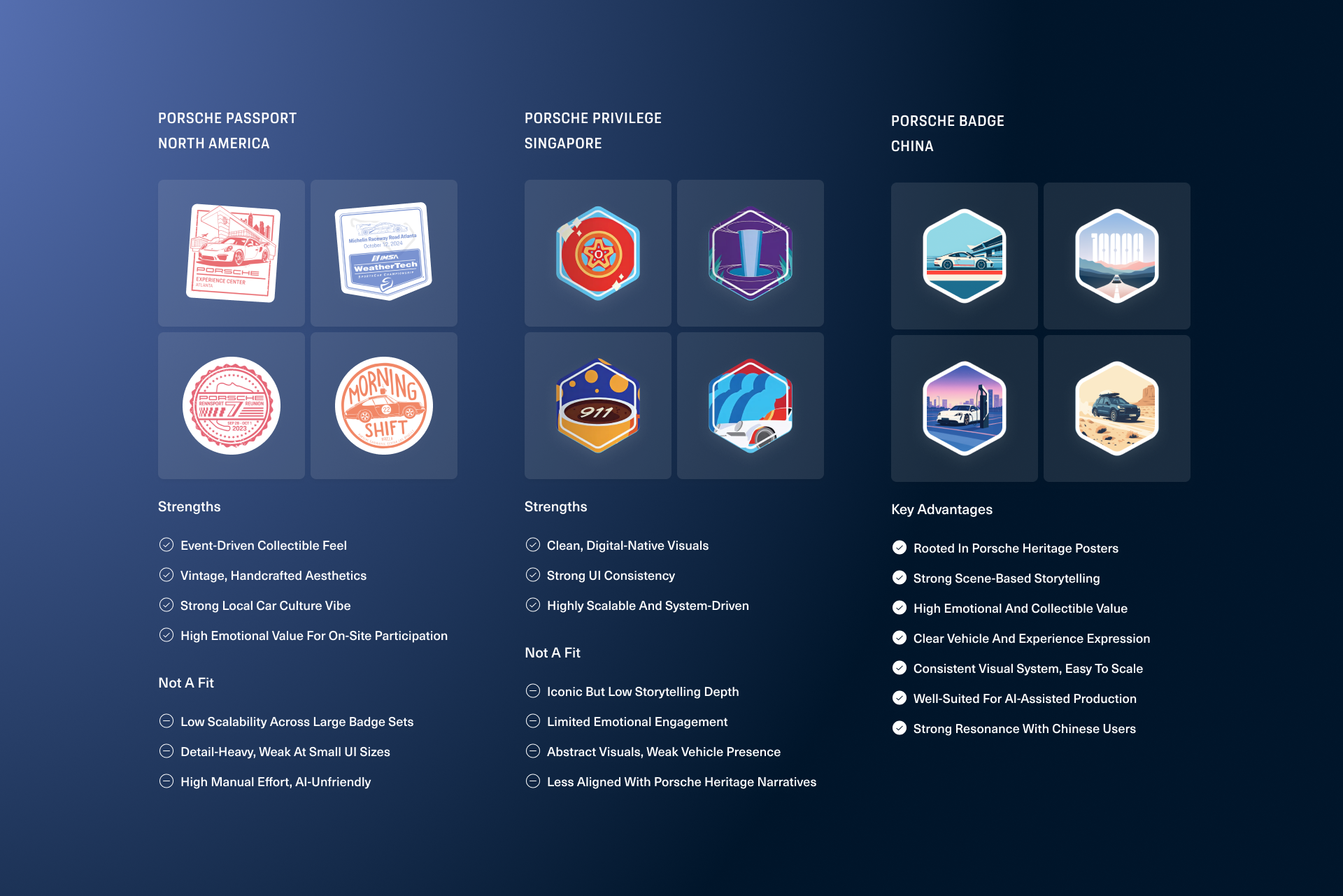
Before designing the Porsche Badge system, multiple existing regional badge styles were reviewed, including Porsche Passport (North America) and Porsche Privilege (Singapore).
While both systems are well-designed and successful within their respective markets, neither fully addressed the combination of business goals, brand storytelling needs, scalability, and production constraints of the China version.
As a result, instead of directly reusing an existing regional style, a new, original badge visual language was developed—rooted in Porsche’s heritage poster aesthetics, yet optimized for digital products and AI-assisted production.
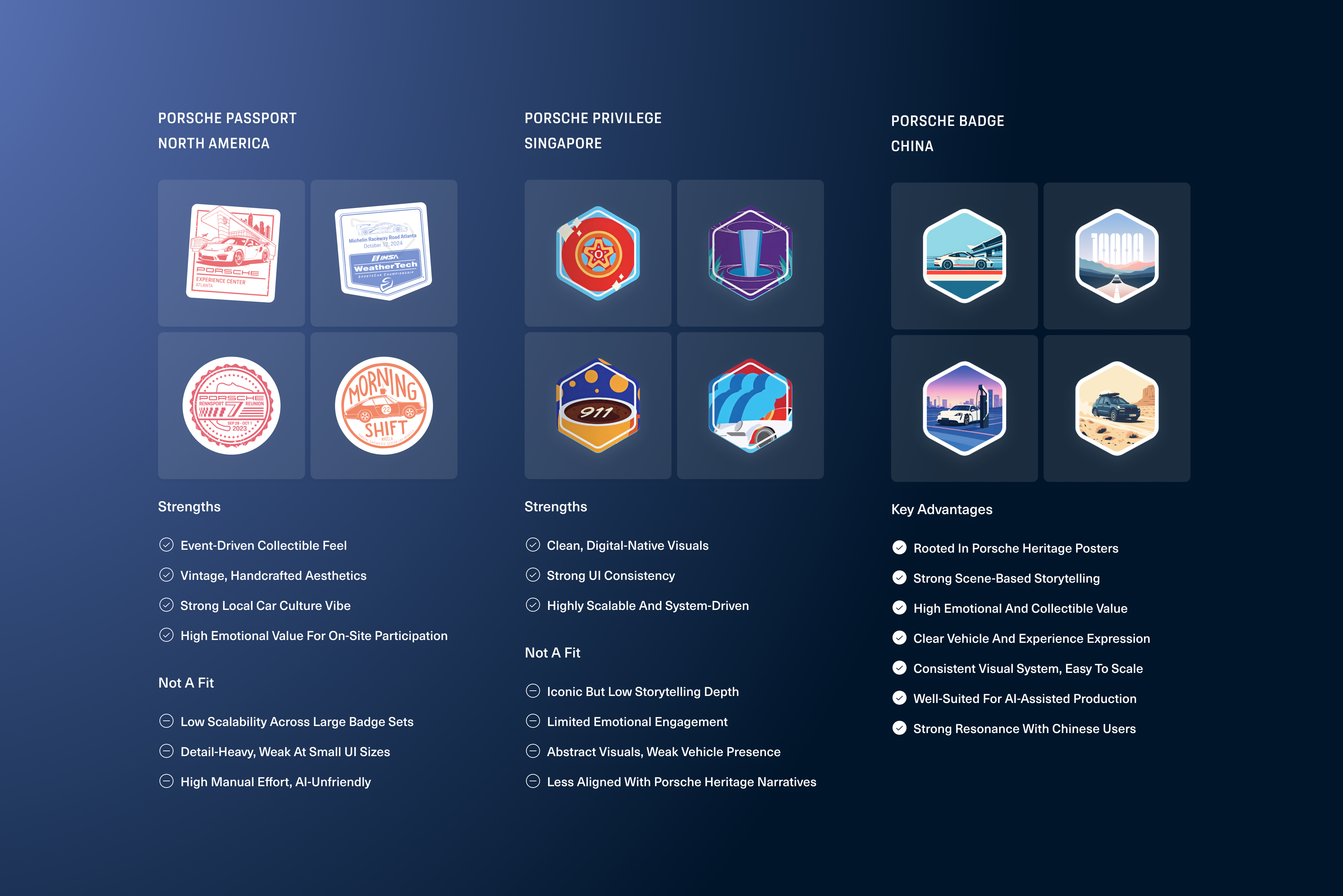
Porsche Achievement System Visual Design - Version Comparison
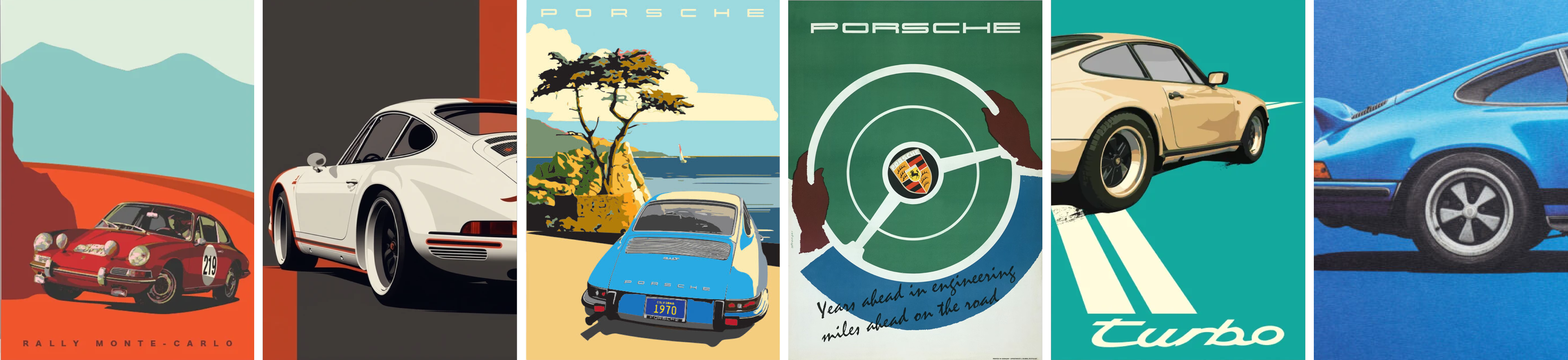
Porsche Badge (China) - Visual Inspiration & AI Training References (Vintage Posters)
The Porsche badge visuals are created through an AI-assisted workflow that balances consistency and flexibility.
Rather than adopting an existing regional badge style, the China badge system introduces a retro-futuristic visual language, inspired by Porsche’s historical poster design tradition and reinterpreted for digital products.
This approach balances heritage and future-facing expression, using vintage poster composition, bold color blocks, and scene-driven storytelling, while remaining scalable, system-oriented, and compatible with AI-assisted creation workflows.
The result is not a nostalgic recreation, but a forward-looking reinterpretation of Porsche’s visual legacy, designed for modern digital experiences.
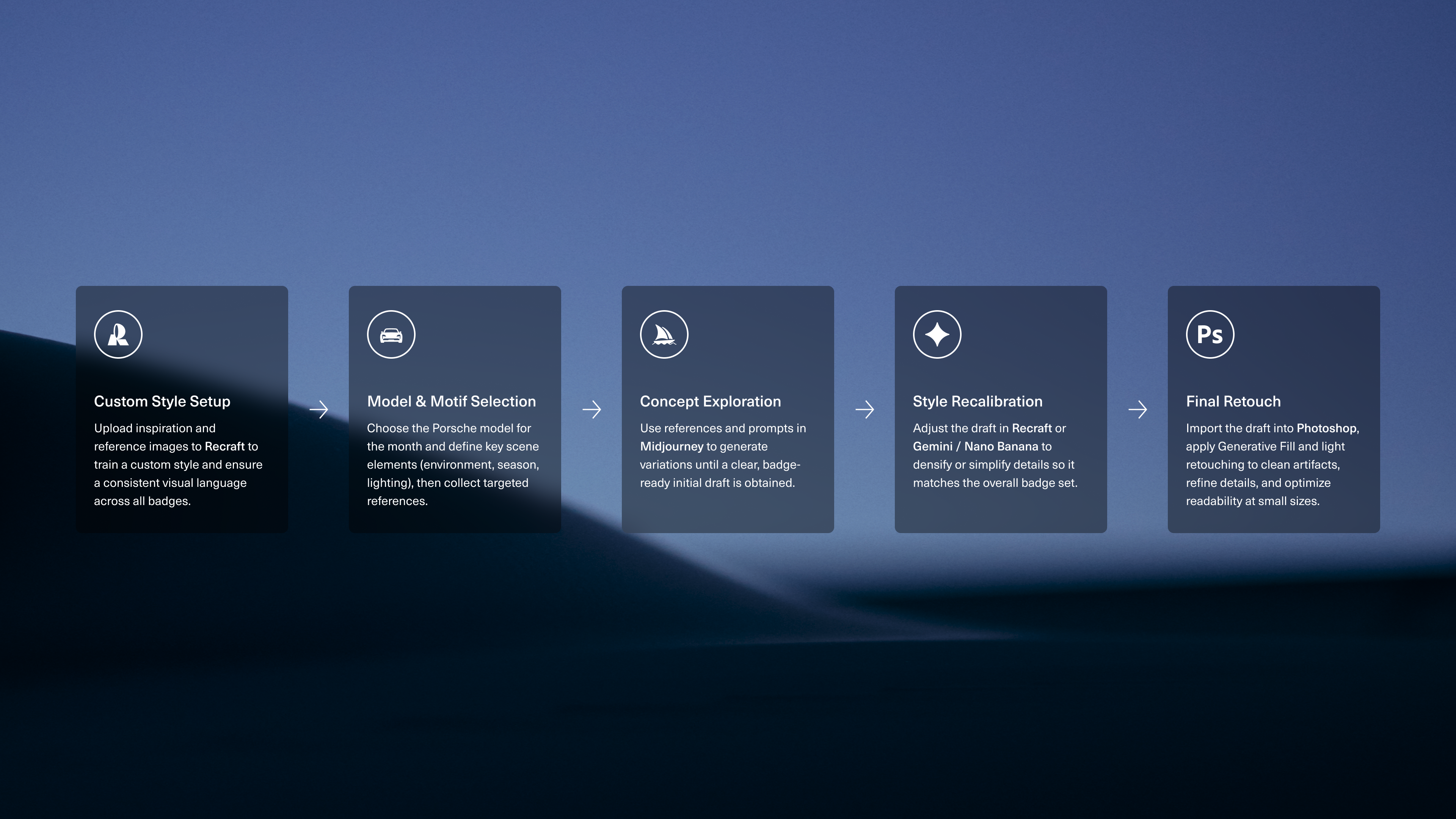
Porsche Badge AI-assisted Production Processes
Interaction & User Flow
The Badge Center is designed as an integrated hub within the Porsche App, providing users with a clear journey from earning to displaying and sharing badges. The experience focuses on clarity, delight, and brand immersion.
User Flow 1: Overview
Users access the Badge Center through their personal profile, reinforcing badges as part of their Porsche identity. The default Highlight tab surfaces newly released badges, limited-time challenges, and recent achievements, driving attention to time-sensitive and high-impact activities.
The All Badges tab offers a complete overview of earned and unearned badges, supporting long-term goal awareness and progress tracking across the Porsche ecosystem.
User Flow 2: Badge Wearing
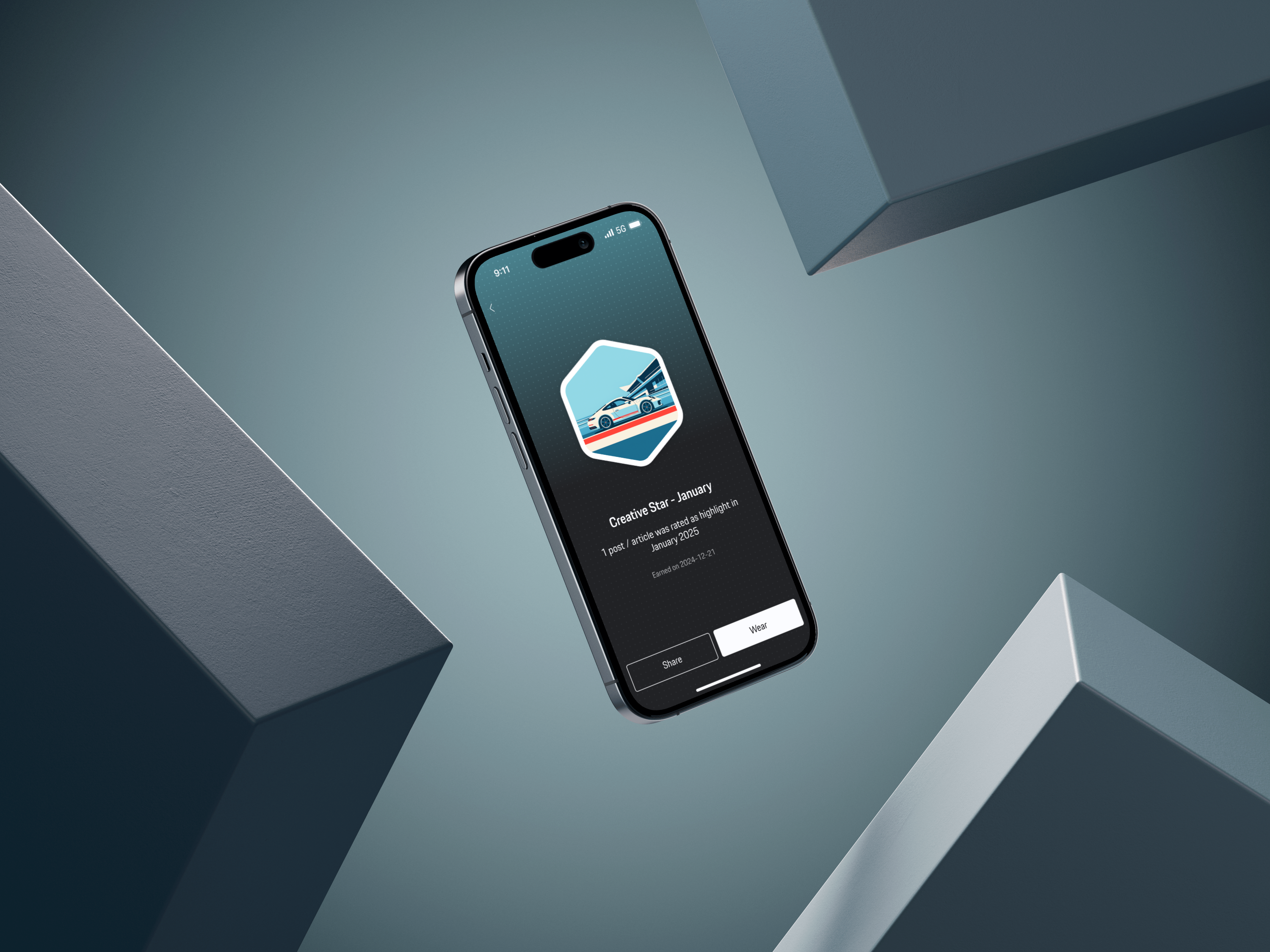
Badge wearing allows users to actively showcase their achievements and extend badge visibility beyond the Badge Center into everyday community interactions.
Users can wear a badge directly from the badge detail page. Once selected, the worn state is consistently reflected across multiple surfaces。
Within the community feed, a mini badge appears next to the user’s avatar on published posts. Tapping the mini badge reveals the full badge details and, when applicable, provides direct access to related tasks. When interacting with other users, tapping their avatar or mini badge opens a dedicated badge overview page, allowing exploration of their achievements.
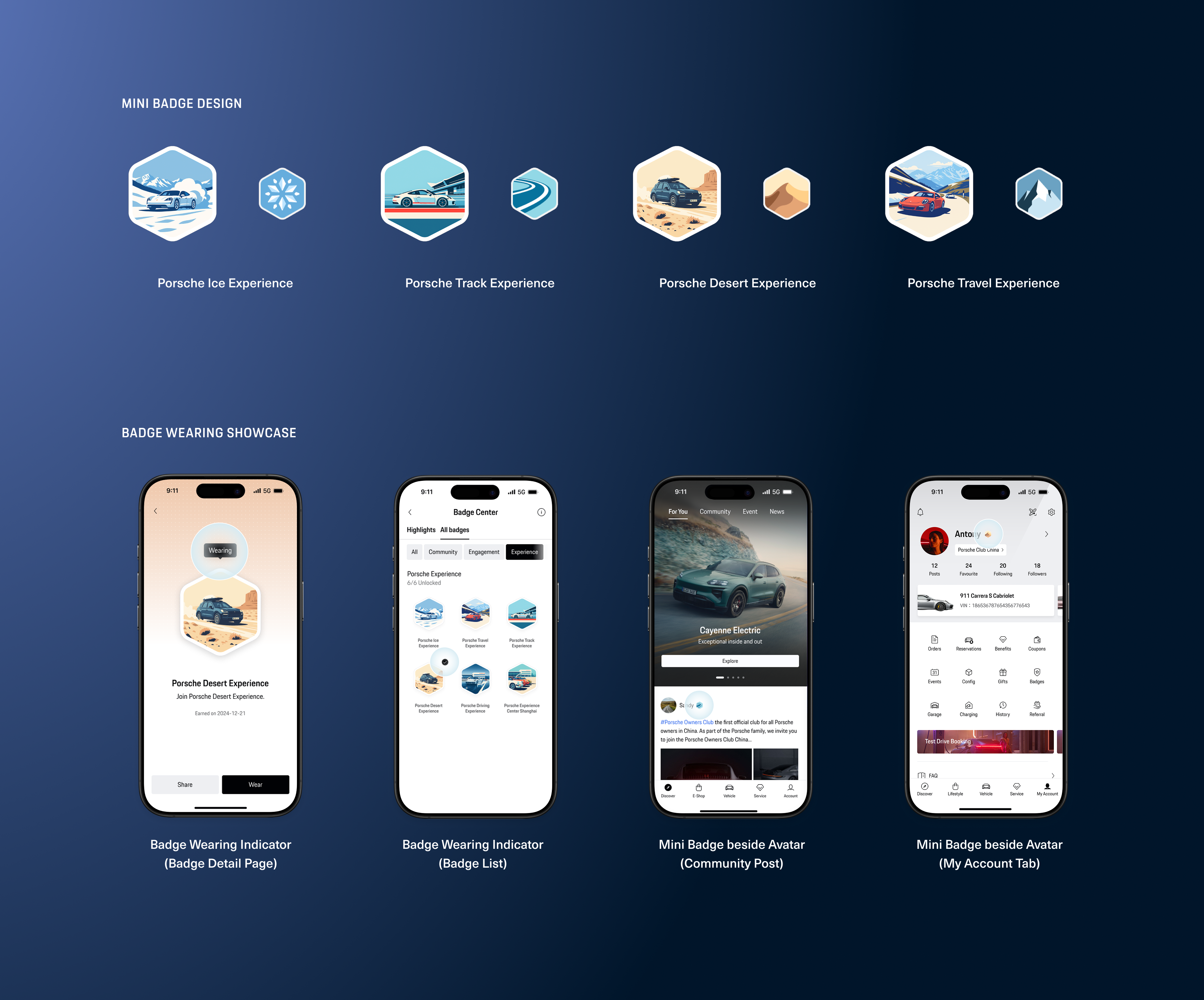
The Badge Wearing System
User Flow 3: Badge Sharing
The sharing flow extends badge recognition beyond the app, allowing users to express personal achievements while amplifying brand visibility across external and internal channels.
From the badge detail page, users can generate a shareable poster and distribute it to WeChat contacts, Moments, Porsche’s internal community, or download it as an image for local use.
To enhance personalization, users can choose from four distinct background textures, each inspired by Porsche legacy design elements. Subtle contextual descriptions introduce the story behind each texture, transforming the poster from a generic share asset into a branded storytelling piece.
User Flow 4: Achievement Notification
When a new badge is unlocked, users receive a real-time App push notification and SMS alert, ensuring timely recognition even when they are not actively using the app. This immediate feedback reinforces a sense of achievement at the moment of completion.
Tapping the lock-screen notification opens a dedicated celebration modal, clearly confirming the newly earned badge through visual emphasis and congratulatory messaging. If multiple badges are unlocked within a short period, they are grouped and displayed together, allowing users to quickly review their latest achievements without navigating through the Badge Center.
From this congratulation view, users can directly share newly earned badges to external channels or the Porsche community, reducing friction between recognition and expression.
User Flow 5: Onboarding
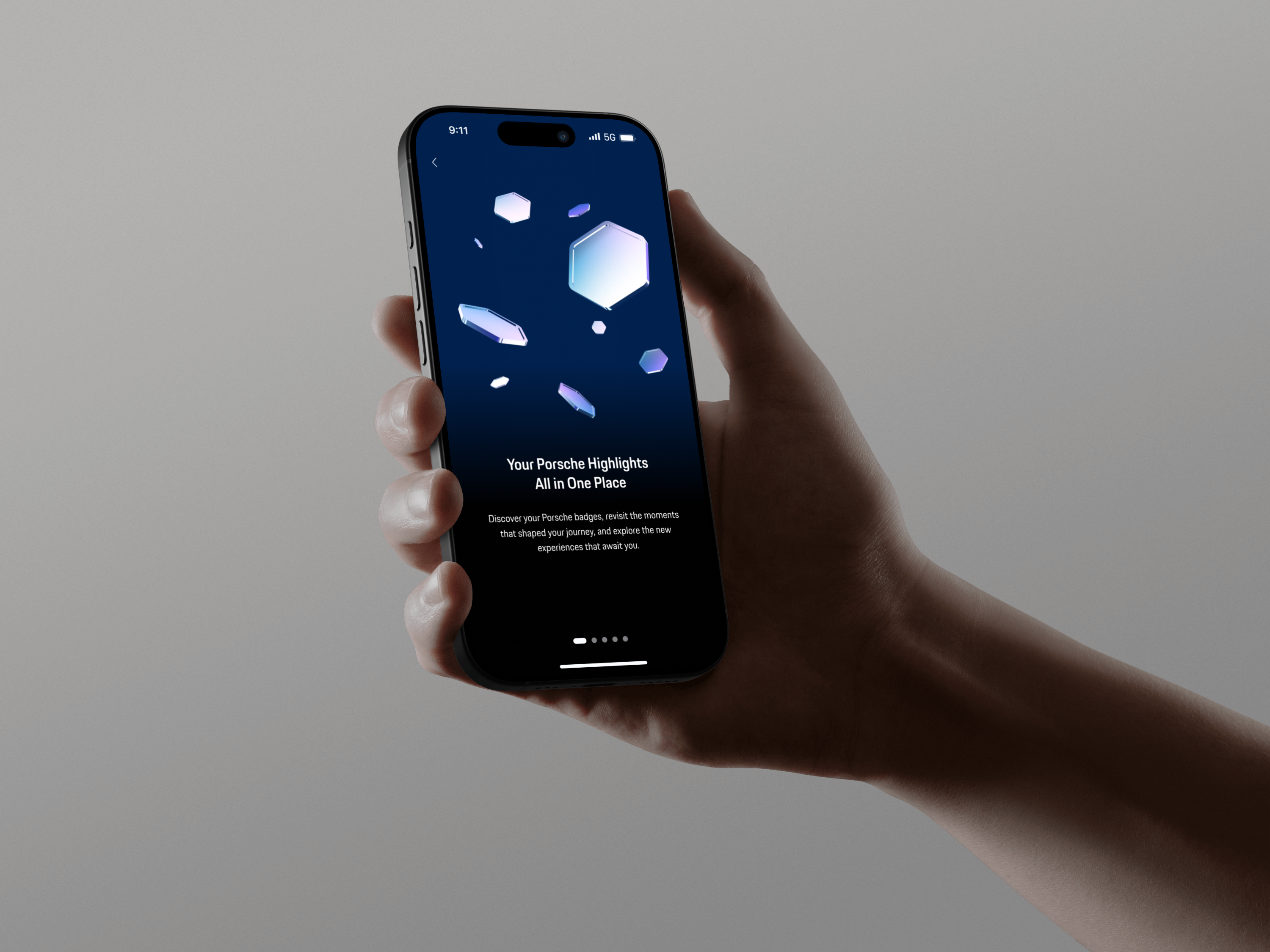
When users enter the Badge Center for the first time, a lightweight onboarding experience introduces the purpose of the system and sets expectations for what users can do inside the Badge Center.
The onboarding highlights the core capabilities at a high level: browsing badge highlights and limited-time challenges, understanding how badges can be unlocked through different activities, wearing badges as part of personal identity, and sharing achievements as posters across social and community channels.
By setting a clear conceptual frame at entry, the onboarding helps first-time users quickly understand the badge experience and feel ready to explore, collect, and share badges as they continue their Porsche journey.
Badge Management System (Operator Console)
To support the long-term scalability of the badge ecosystem, a dedicated badge management system was designed for operations teams. Rather than treating badges as static visual assets, the system positions them as configurable, lifecycle-based products. This enables non-design and non-engineering stakeholders to independently manage badge creation, publishing, distribution, and retirement. By separating badge operations from core app development, the system allows the badge program to scale sustainably as a business growth and engagement tool.
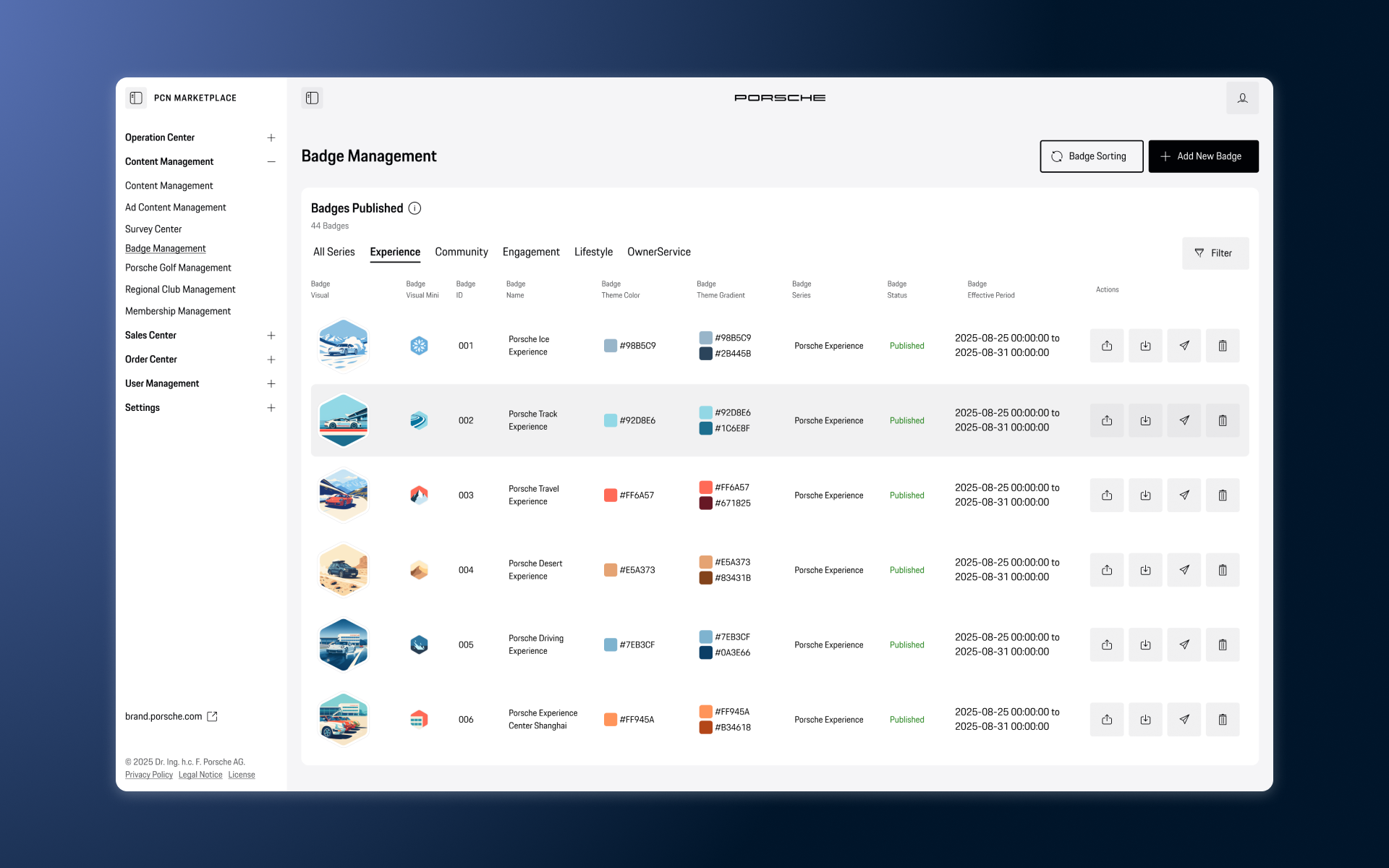
Badge Management - Badge List
The badge list view acts as the operational dashboard for all existing badges. It provides a centralized overview of every badge that has been created and deployed, including their visual identity, series classification, publication status, and effective period. From this interface, operators can publish or unpublish badges, manually issue them for specific campaigns or user groups, or remove them when they are no longer relevant. This design ensures that badge campaigns can be launched, adjusted, or retired quickly without disrupting the broader product experience.
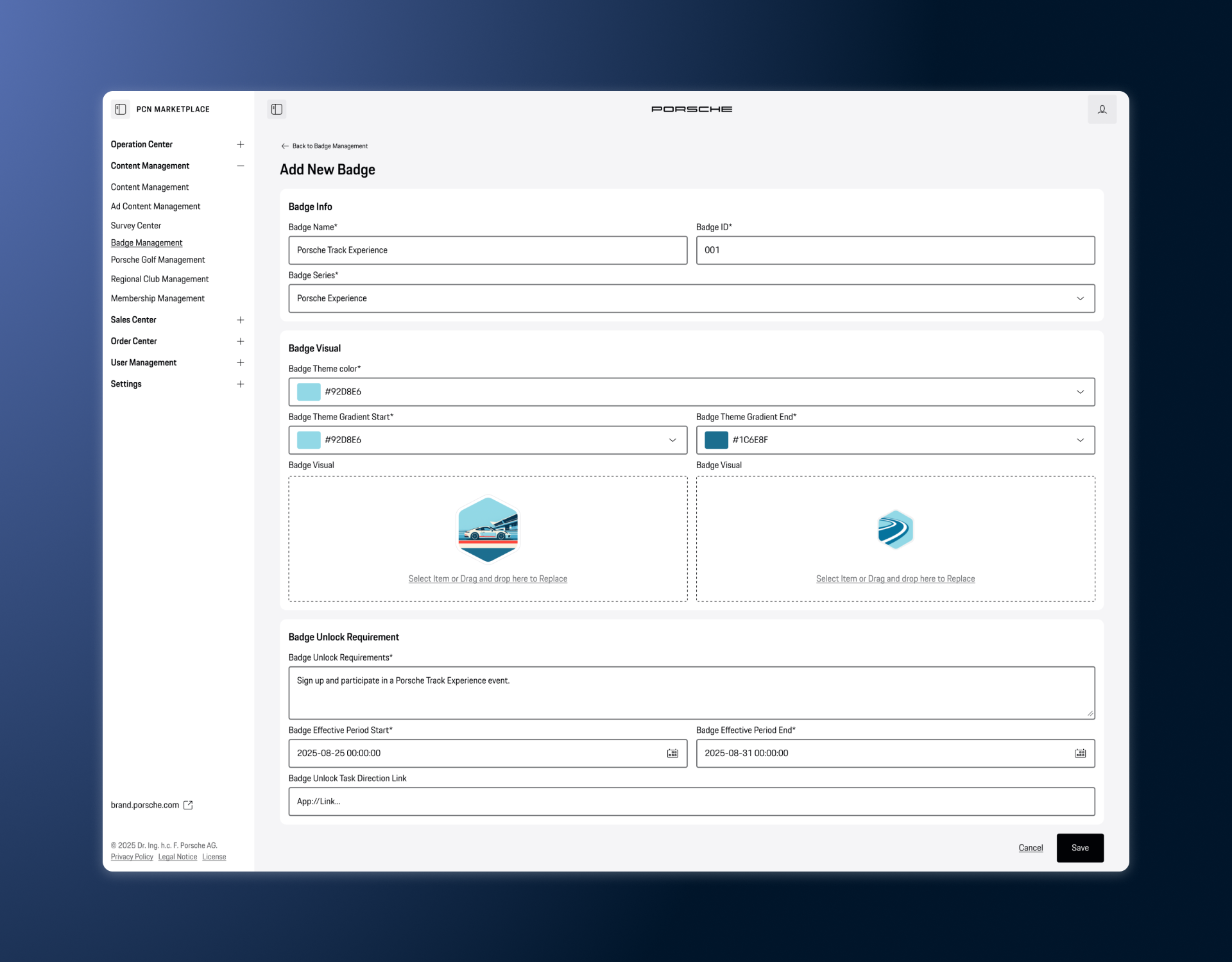
Badge Management - Add New Badge
The Add New Badge interface is designed as a structured configuration workflow rather than a one-off content upload. Operators can define badge metadata, visuals, gradients, unlock requirements, active time windows, and deep links to related user actions such as test drives, events, or purchases. By consolidating all configuration steps into a single form, the system minimizes cross-team dependencies while ensuring that each new badge is visually consistent, technically valid, and directly connected to measurable user behaviors.
Performance & Impact
Data Strategy & Monitoring
To scientifically evaluate the Badge System's performance, we established a comprehensive event-tracking framework. Leveraging GrowingIO, we monitor user behavioral paths in real-time, performing end-to-end analysis, from macro-level module activity to micro-level performance of individual badges. This data-driven approach allows us to pinpoint UX bottlenecks rapidly and provides a solid quantitative foundation for iterative optimizations.
Badge Management - Badge List
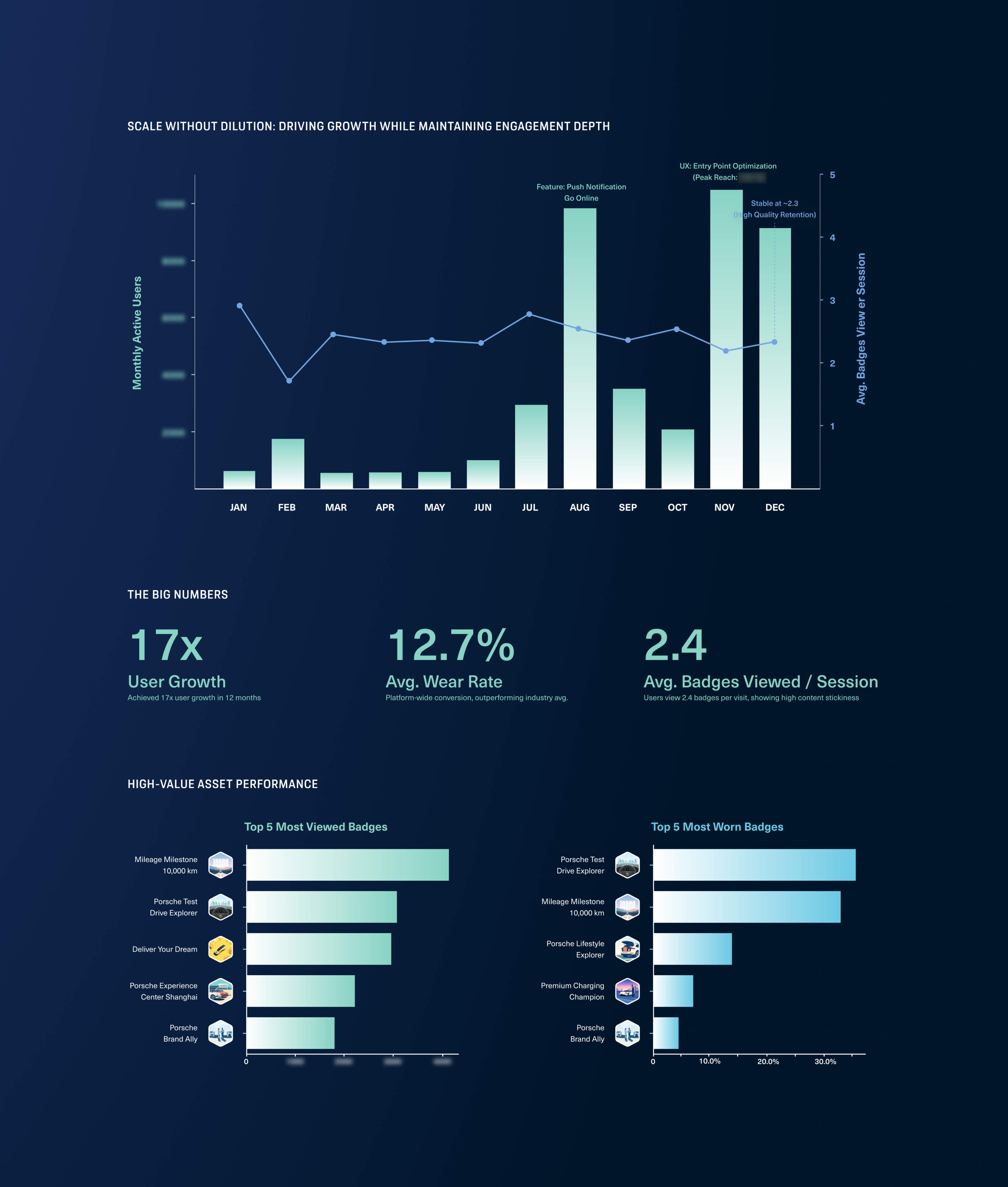
Visualized Growth: The Performance Duo
The core data visualization illustrates the evolution of the system over the past year:
Scale (Traffic): The mint bars record two significant traffic spikes triggered by our design interventions, the launch of Push Notifications in August and Entry Point Optimization in November, driving a 17x explosion in Monthly Active Users (MAU) over the year.
Quality (Depth): The blue line (Average Exploration Depth) remained remarkably stable between 2.3 - 2.6 in the recent 6 months, proving that the system maintained high content stickiness and exploration value even during massive user influx.
Key Insights & Business Value
Deep-dive analysis into the rankings and conversion data yields the following conclusions:
Platform-Wide Conversion: The global average wear rate reached 12.7%, meaning 1 out of every 8 badge views resulted in a "wearing" action, a conversion performance that far exceeds industry benchmarks for digital collectibles.
Effectiveness of Design Intervention: Data fluctuations align perfectly with functional iteration cycles, validating the critical role of entry-point elevation and trigger mechanisms (Notifications) in boosting digital asset exposure.
Future Vision & Scalability
Looking ahead, the badge system is designed to evolve from static recognition into a more immersive and progressive engagement experience, supporting long-term participation and scalable content expansion across the Porsche ecosystem.
Dynamic Badges & Immersive Presentation
Dynamic badges introduce motion and depth to the achievement experience. When users tap a static badge, it transitions into a full-screen animation, allowing them to explore a more immersive and cinematic presentation of the achievement. This animation can be exported and shared as a video poster on social platforms, extending badge visibility beyond the app and enhancing emotional resonance through richer storytelling.
Badge Levels & Progress Visualization
To support sustained engagement, selected badges will be designed with multiple levels, unlocked through continued participation. For badges not yet achieved, real-time progress indicators clearly communicate how close users are to completion. This approach transforms badges from one-time rewards into ongoing goals, encouraging repeat actions while keeping motivation transparent and non-intrusive.
Conclusion & Reflection
Conclusion: Bridging Brand Identity and Business Growth
The Porsche Badge Center turned digital incentives into a growth engine, achieving 17x MAU growth and a 12.7% average wear rate. By linking rewards to high-value actions like test drives (which saw a 35.7% conversion), the project successfully built digital brand equity and supported Porsche’s transition into a holistic brand ecosystem.
Reflection: Data-Driven Systemic Design
AI Workflow & Efficiency: I developed a high-speed pipeline using Midjourney, Recraft, NanoBanana, and Photoshop. By exploring the unique characteristics of each tool, I achieved a multi-fold increase in output, while maintaining Porsche's high-fidelity aesthetic.
Data as the North Star: Using GrowingIO for attribution analysis, I moved beyond intuition to validate design interventions with quantifiable commercial value.

User Achievement and Reward System
Porsche Badge Center

Project Type
Mobile App
Timeline
June 2024 – Recent
My Role
Product Designer
Tools
Figma,AI models/tools
Porsche Badge Center is a digital engagement feature within the Porsche ecosystem that turns brand interactions, such as test drives, event participation, and lifestyle purchases, into collectible digital badges celebrating user milestones.
Initiated as part of a retention and engagement strategy, the project’s goal was to design a reward system that aligns with Porsche’s premium identity while encouraging ongoing participation.
With limited design resources, an AI-assisted workflow was established to generate badge visuals at scale while maintaining stylistic consistency. Each badge draws from Porsche’s design heritage, featuring monthly themes inspired by seasonal tones and vehicle models.
The Badge Center interface allows users to browse, earn, and share badges seamlessly, integrating notification flows, tier progression, and social sharing to reinforce a sense of recognition and belonging.
Project Context
Porsche aimed to enhance user engagement and retention through a gamified digital recognition system, turning milestones such as test drives, events, and purchases into personalized achievements.
Problem Statement
“Designing a scalable, premium digital achievement system that drives engagement while preserving Porsche’s brand integrity.”
Business Value & System Roadmap
The Porsche Badge System was designed as a long-term engagement engine rather than a one-off incentive feature. By transforming meaningful user actions into visible achievements, the system reinforces participation, encourages sharing, and continuously feeds back into Porsche’s digital ecosystem.
At its core, the badge system operates as an engagement loop: user activities generate badges, badges gain visibility through profile display and community exposure, and this visibility in turn inspires further participation and brand interaction. In this way, badges function not only as rewards, but as persistent touchpoints that amplify engagement across multiple channels.
Porsche Badge - Business Value Flywheel
To balance business value and feasibility, the roadmap followed three phases:
Phase 1 prioritized low-effort, high-frequency scenarios (e.g., community, golf) for rapid validation. Phase 2 expanded to conversion-driven platforms like test drives to boost participation. Phase 3 targets deep vehicle integrations (e.g., Porsche Connect)—positioned later due to complexity, despite high retention potential.
This strategy ensured the system scaled effectively from lightweight incentives to deeply embedded brand touchpoints.
Porsche Badge - Product Development Roadmap

Badge Design & Visual System
Before designing the Porsche Badge system, multiple existing regional badge styles were reviewed, including Porsche Passport (North America) and Porsche Privilege (Singapore).
While both systems are well-designed and successful within their respective markets, neither fully addressed the combination of business goals, brand storytelling needs, scalability, and production constraints of the China version.
As a result, instead of directly reusing an existing regional style, a new, original badge visual language was developed—rooted in Porsche’s heritage poster aesthetics, yet optimized for digital products and AI-assisted production.
Porsche Achievement System Visual Design - Version Comparison
Porsche Badge (China) - Visual Inspiration & AI Training References (Vintage Posters)
Porsche Badge AI-assisted Production Processes
The Porsche badge visuals are created through an AI-assisted workflow that balances consistency and flexibility.
Rather than adopting an existing regional badge style, the China badge system introduces a retro-futuristic visual language, inspired by Porsche’s historical poster design tradition and reinterpreted for digital products.
This approach balances heritage and future-facing expression, using vintage poster composition, bold color blocks, and scene-driven storytelling, while remaining scalable, system-oriented, and compatible with AI-assisted creation workflows.
The result is not a nostalgic recreation, but a forward-looking reinterpretation of Porsche’s visual legacy, designed for modern digital experiences.
Porsche Badge Visual Gallery
Interaction & User Flow
The Badge Center is designed as an integrated hub within the Porsche App, providing users with a clear journey from earning to displaying and sharing badges. The experience focuses on clarity, delight, and brand immersion.
User Flow 1: Overview
Users access the Badge Center through their personal profile, reinforcing badges as part of their Porsche identity. The default Highlight tab surfaces newly released badges, limited-time challenges, and recent achievements, driving attention to time-sensitive and high-impact activities.
The All Badges tab offers a complete overview of earned and unearned badges, supporting long-term goal awareness and progress tracking across the Porsche ecosystem.
User Flow 2: Badge Wearing
Badge wearing allows users to actively showcase their achievements and extend badge visibility beyond the Badge Center into everyday community interactions.
Users can wear a badge directly from the badge detail page. Once selected, the worn state is consistently reflected across multiple surfaces。
Within the community feed, a mini badge appears next to the user’s avatar on published posts. Tapping the mini badge reveals the full badge details and, when applicable, provides direct access to related tasks. When interacting with other users, tapping their avatar or mini badge opens a dedicated badge overview page, allowing exploration of their achievements.
The Badge Wearing System
User Flow 3: Badge Sharing
The sharing flow extends badge recognition beyond the app, allowing users to express personal achievements while amplifying brand visibility across external and internal channels.
From the badge detail page, users can generate a shareable poster and distribute it to WeChat contacts, Moments, Porsche’s internal community, or download it as an image for local use.
To enhance personalization, users can choose from four distinct background textures, each inspired by Porsche legacy design elements. Subtle contextual descriptions introduce the story behind each texture, transforming the poster from a generic share asset into a branded storytelling piece.
User Flow 4: Achievement Notification
When a new badge is unlocked, users receive a real-time App push notification and SMS alert, ensuring timely recognition even when they are not actively using the app. This immediate feedback reinforces a sense of achievement at the moment of completion.
Tapping the lock-screen notification opens a dedicated celebration modal, clearly confirming the newly earned badge through visual emphasis and congratulatory messaging. If multiple badges are unlocked within a short period, they are grouped and displayed together, allowing users to quickly review their latest achievements without navigating through the Badge Center.
From this congratulation view, users can directly share newly earned badges to external channels or the Porsche community, reducing friction between recognition and expression.
User Flow 5: Onboarding
When users enter the Badge Center for the first time, a lightweight onboarding experience introduces the purpose of the system and sets expectations for what users can do inside the Badge Center.
The onboarding highlights the core capabilities at a high level: browsing badge highlights and limited-time challenges, understanding how badges can be unlocked through different activities, wearing badges as part of personal identity, and sharing achievements as posters across social and community channels.
By setting a clear conceptual frame at entry, the onboarding helps first-time users quickly understand the badge experience and feel ready to explore, collect, and share badges as they continue their Porsche journey.
Badge Management System (Operator Console)
To support the long-term scalability of the badge ecosystem, a dedicated badge management system was designed for operations teams. Rather than treating badges as static visual assets, the system positions them as configurable, lifecycle-based products. This enables non-design and non-engineering stakeholders to independently manage badge creation, publishing, distribution, and retirement. By separating badge operations from core app development, the system allows the badge program to scale sustainably as a business growth and engagement tool.
Badge Management - Badge List
The badge list view acts as the operational dashboard for all existing badges. It provides a centralized overview of every badge that has been created and deployed, including their visual identity, series classification, publication status, and effective period. From this interface, operators can publish or unpublished badges, manually issue them for specific campaigns or user groups, or remove them when they are no longer relevant. This design ensures that badge campaigns can be launched, adjusted, or retired quickly without disrupting the broader product experience.
Badge Management - Add New Badge
The Add New Badge interface is designed as a structured configuration workflow rather than a one-off content upload. Operators can define badge metadata, visuals, gradients, unlock requirements, active time windows, and deep links to related user actions such as test drives, events, or purchases. By consolidating all configuration steps into a single form, the system minimizes cross-team dependencies while ensuring that each new badge is visually consistent, technically valid, and directly connected to measurable user behaviors.
Performance & Impact
To scientifically evaluate the Badge System's performance, we established a comprehensive event-tracking framework. Leveraging GrowingIO, we monitor user behavioral paths in real-time, performing end-to-end analysis, from macro-level module activity to micro-level performance of individual badges. This data-driven approach allows us to pinpoint UX bottlenecks rapidly and provides a solid quantitative foundation for iterative optimizations.
Badge Management - Badge List
Visualized Growth: The Performance Duo
The core data visualization illustrates the evolution of the system over the past year:
Scale (Traffic): The mint bars record two significant traffic spikes triggered by our design interventions, the launch of Push Notifications in August and Entry Point Optimization in November, driving a 17x explosion in Monthly Active Users (MAU) over the year.
Quality (Depth): The blue line (Average Exploration Depth) remained remarkably stable between 2.3 - 2.6 in the recent 6 months, proving that the system maintained high content stickiness and exploration value even during massive user influx.
Key Insights & Business Value
Deep-dive analysis into the rankings and conversion data yields the following conclusions:
Platform-Wide Conversion: The global average wear rate reached 12.7%, meaning 1 out of every 8 badge views resulted in a "wearing" action, a conversion performance that far exceeds industry benchmarks for digital collectibles.
Effectiveness of Design Intervention: Data fluctuations align perfectly with functional iteration cycles, validating the critical role of entry-point elevation and trigger mechanisms (Notifications) in boosting digital asset exposure.
Future Vision & Scalability
Looking ahead, the badge system is designed to evolve from static recognition into a more immersive and progressive engagement experience, supporting long-term participation and scalable content expansion across the Porsche ecosystem.
Dynamic Badges & Immersive Presentation
Dynamic badges introduce motion and depth to the achievement experience. When users tap a static badge, it transitions into a full-screen animation, allowing them to explore a more immersive and cinematic presentation of the achievement. This animation can be exported and shared as a video poster on social platforms, extending badge visibility beyond the app and enhancing emotional resonance through richer storytelling.
Badge Levels & Progress Visualization
To support sustained engagement, selected badges will be designed with multiple levels, unlocked through continued participation. For badges not yet achieved, real-time progress indicators clearly communicate how close users are to completion. This approach transforms badges from one-time rewards into ongoing goals, encouraging repeat actions while keeping motivation transparent and non-intrusive.
Conclusion & Reflection
Conclusion: Bridging Brand Identity and Business Growth
The Porsche Badge Center turned digital incentives into a growth engine, achieving 17x MAU growth and a 12.7% average wear rate. By linking rewards to high-value actions like test drives (which saw a 35.7% conversion), the project successfully built digital brand equity and supported Porsche’s transition into a holistic brand ecosystem.
Reflection: Data-Driven Systemic Design
AI Workflow & Efficiency: I developed a high-speed pipeline using Midjourney, Recraft, NanoBanana, and Photoshop. By exploring the unique characteristics of each tool, I achieved a multi-fold increase in output, while maintaining Porsche's high-fidelity aesthetic.
Data as the North Star: Using GrowingIO for attribution analysis, I moved beyond intuition to validate design interventions with quantifiable commercial value.

User Achievement and Reward System
Porsche Badge Center

Project Type
Mobile App
Timeline
June 2024 – Recent
My Role
Product Designer
Tools
Figma,Mid-journey, Redraft and more AI models/toolsAdobe Suite
Porsche Badge Center is a digital engagement feature within the Porsche ecosystem that turns brand interactions, such as test drives, event participation, and lifestyle purchases, into collectible digital badges celebrating user milestones.
Initiated as part of a retention and engagement strategy, the project’s goal was to design a reward system that aligns with Porsche’s premium identity while encouraging ongoing participation.
With limited design resources, an AI-assisted workflow was established to generate badge visuals at scale while maintaining stylistic consistency. Each badge draws from Porsche’s design heritage, featuring monthly themes inspired by seasonal tones and vehicle models.
The Badge Center interface allows users to browse, earn, and share badges seamlessly, integrating notification flows, tier progression, and social sharing to reinforce a sense of recognition and belonging.
Project Context
Porsche aimed to enhance user engagement and retention through a gamified digital recognition system, turning milestones such as test drives, events, and purchases into personalized achievements.
Problem Statement
“Designing a scalable, premium digital achievement system that drives engagement while preserving Porsche’s brand integrity.”
Business Value & System Roadmap
The Porsche Badge System was designed as a long-term engagement engine rather than a one-off incentive feature. By transforming meaningful user actions into visible achievements, the system reinforces participation, encourages sharing, and continuously feeds back into Porsche’s digital ecosystem.
At its core, the badge system operates as an engagement loop: user activities generate badges, badges gain visibility through profile display and community exposure, and this visibility in turn inspires further participation and brand interaction. In this way, badges function not only as rewards, but as persistent touchpoints that amplify engagement across multiple channels.
Porsche Badge - Business Value Flywheel
To balance business value and feasibility, the roadmap followed three phases:
Phase 1 prioritized low-effort, high-frequency scenarios (e.g., community, golf) for rapid validation. Phase 2 expanded to conversion-driven platforms like test drives to boost participation. Phase 3 targets deep vehicle integrations (e.g., Porsche Connect)—positioned later due to complexity, despite high retention potential.
This strategy ensured the system scaled effectively from lightweight incentives to deeply embedded brand touchpoints.
Porsche Badge - Product Development Roadmap

Badge Design & Visual System
Before designing the Porsche Badge system, multiple existing regional badge styles were reviewed, including Porsche Passport (North America) and Porsche Privilege (Singapore).
While both systems are well-designed and successful within their respective markets, neither fully addressed the combination of business goals, brand storytelling needs, scalability, and production constraints of the China version.
As a result, instead of directly reusing an existing regional style, a new, original badge visual language was developed—rooted in Porsche’s heritage poster aesthetics, yet optimized for digital products and AI-assisted production.
Porsche Achievement System Visual Design - Version Comparison
Porsche Badge (China) - Visual Inspiration & AI Training References (Vintage Posters)
The Porsche badge visuals are created through an AI-assisted workflow that balances consistency and flexibility.
Porsche Badge AI-assisted Production Processes
Rather than adopting an existing regional badge style, the China badge system introduces a retro-futuristic visual language, inspired by Porsche’s historical poster design tradition and reinterpreted for digital products.
This approach balances heritage and future-facing expression, using vintage poster composition, bold color blocks, and scene-driven storytelling, while remaining scalable, system-oriented, and compatible with AI-assisted creation workflows.
The result is not a nostalgic recreation, but a forward-looking reinterpretation of Porsche’s visual legacy, designed for modern digital experiences.
Porsche Badge Visual Gallery
Interaction & User Flow
The Badge Center is designed as an integrated hub within the Porsche App, providing users with a clear journey from earning to displaying and sharing badges. The experience focuses on clarity, delight, and brand immersion.
User Flow 1: Overview
Users access the Badge Center through their personal profile, reinforcing badges as part of their Porsche identity. The default Highlight tab surfaces newly released badges, limited-time challenges, and recent achievements, driving attention to time-sensitive and high-impact activities.
The All Badges tab offers a complete overview of earned and unearned badges, supporting long-term goal awareness and progress tracking across the Porsche ecosystem.
User Flow 2: Badge Wearing
Badge wearing allows users to actively showcase their achievements and extend badge visibility beyond the Badge Center into everyday community interactions.
Users can wear a badge directly from the badge detail page. Once selected, the worn state is consistently reflected across multiple surfaces。
Within the community feed, a mini badge appears next to the user’s avatar on published posts. Tapping the mini badge reveals the full badge details and, when applicable, provides direct access to related tasks. When interacting with other users, tapping their avatar or mini badge opens a dedicated badge overview page, allowing exploration of their achievements.
The Badge Wearing System
User Flow 3: Badge Sharing
The sharing flow extends badge recognition beyond the app, allowing users to express personal achievements while amplifying brand visibility across external and internal channels.
From the badge detail page, users can generate a shareable poster and distribute it to WeChat contacts, Moments, Porsche’s internal community, or download it as an image for local use.
To enhance personalization, users can choose from four distinct background textures, each inspired by Porsche legacy design elements. Subtle contextual descriptions introduce the story behind each texture, transforming the poster from a generic share asset into a branded storytelling piece.
User Flow 4: Achievement Notification
When a new badge is unlocked, users receive a real-time App push notification and SMS alert, ensuring timely recognition even when they are not actively using the app. This immediate feedback reinforces a sense of achievement at the moment of completion.
Tapping the lock-screen notification opens a dedicated celebration modal, clearly confirming the newly earned badge through visual emphasis and congratulatory messaging. If multiple badges are unlocked within a short period, they are grouped and displayed together, allowing users to quickly review their latest achievements without navigating through the Badge Center.
From this congratulation view, users can directly share newly earned badges to external channels or the Porsche community, reducing friction between recognition and expression.
User Flow 5: Onboarding
When users enter the Badge Center for the first time, a lightweight onboarding experience introduces the purpose of the system and sets expectations for what users can do inside the Badge Center.
The onboarding highlights the core capabilities at a high level: browsing badge highlights and limited-time challenges, understanding how badges can be unlocked through different activities, wearing badges as part of personal identity, and sharing achievements as posters across social and community channels.
By setting a clear conceptual frame at entry, the onboarding helps first-time users quickly understand the badge experience and feel ready to explore, collect, and share badges as they continue their Porsche journey.
Future Vision & Scalability
Looking ahead, the badge system is designed to evolve from static recognition into a more immersive and progressive engagement experience, supporting long-term participation and scalable content expansion across the Porsche ecosystem.
Dynamic Badges & Immersive Presentation
Dynamic badges introduce motion and depth to the achievement experience. When users tap a static badge, it transitions into a full-screen animation, allowing them to explore a more immersive and cinematic presentation of the achievement. This animation can be exported and shared as a video poster on social platforms, extending badge visibility beyond the app and enhancing emotional resonance through richer storytelling.
Badge Levels & Progress Visualization
To support sustained engagement, selected badges will be designed with multiple levels, unlocked through continued participation. For badges not yet achieved, real-time progress indicators clearly communicate how close users are to completion. This approach transforms badges from one-time rewards into ongoing goals, encouraging repeat actions while keeping motivation transparent and non-intrusive.
Badge Management System (Operator Console)
To support the long-term scalability of the badge ecosystem, a dedicated badge management system was designed for operations teams. Rather than treating badges as static visual assets, the system positions them as configurable, lifecycle-based products. This enables non-design and non-engineering stakeholders to independently manage badge creation, publishing, distribution, and retirement. By separating badge operations from core app development, the system allows the badge program to scale sustainably as a business growth and engagement tool.
Badge Management - Badge List
The badge list view acts as the operational dashboard for all existing badges. It provides a centralized overview of every badge that has been created and deployed, including their visual identity, series classification, publication status, and effective period. From this interface, operators can publish or unpublish badges, manually issue them for specific campaigns or user groups, or remove them when they are no longer relevant. This design ensures that badge campaigns can be launched, adjusted, or retired quickly without disrupting the broader product experience.
Badge Management - Add New Badge
The Add New Badge interface is designed as a structured configuration workflow rather than a one-off content upload. Operators can define badge metadata, visuals, gradients, unlock requirements, active time windows, and deep links to related user actions such as test drives, events, or purchases. By consolidating all configuration steps into a single form, the system minimizes cross-team dependencies while ensuring that each new badge is visually consistent, technically valid, and directly connected to measurable user behaviors.
Performance & Impact
Data Strategy & Monitoring
To scientifically evaluate the Badge System's performance, we established a comprehensive event-tracking framework. Leveraging GrowingIO, we monitor user behavioral paths in real-time, performing end-to-end analysis, from macro-level module activity to micro-level performance of individual badges. This data-driven approach allows us to pinpoint UX bottlenecks rapidly and provides a solid quantitative foundation for iterative optimizations.
Badge Management - Badge List
Visualized Growth: The Performance Duo
The core data visualization illustrates the evolution of the system over the past year:
Scale (Traffic): The mint bars record two significant traffic spikes triggered by our design interventions, the launch of Push Notifications in August and Entry Point Optimization in November, driving a 17x explosion in Monthly Active Users (MAU) over the year.
Quality (Depth): The blue line (Average Exploration Depth) remained remarkably stable between 2.3 - 2.6 in the recent 6 months, proving that the system maintained high content stickiness and exploration value even during massive user influx.
Key Insights & Business Value
Deep-dive analysis into the rankings and conversion data yields the following conclusions:
Platform-Wide Conversion: The global average wear rate reached 12.7%, meaning 1 out of every 8 badge views resulted in a "wearing" action, a conversion performance that far exceeds industry benchmarks for digital collectibles.
Effectiveness of Design Intervention: Data fluctuations align perfectly with functional iteration cycles, validating the critical role of entry-point elevation and trigger mechanisms (Notifications) in boosting digital asset exposure.
Conclusion & Reflection
Conclusion: Bridging Brand Identity and Business Growth
The Porsche Badge Center turned digital incentives into a growth engine, achieving 17x MAU growth and a 12.7% average wear rate. By linking rewards to high-value actions like test drives (which saw a 35.7% conversion), the project successfully built digital brand equity and supported Porsche’s transition into a holistic brand ecosystem.
Reflection: Data-Driven Systemic Design
AI Workflow & Efficiency: I developed a high-speed pipeline using Midjourney, Recraft, NanoBanana, and Photoshop. By exploring the unique characteristics of each tool, I achieved a multi-fold increase in output, while maintaining Porsche's high-fidelity aesthetic.
Data as the North Star: Using GrowingIO for attribution analysis, I moved beyond intuition to validate design interventions with quantifiable commercial value.
